

📖This article is part of the complete guide to Epoxy Garage Floor Coating.
A cracked or stained concrete garage floor is more than just an eyesore; in the specific climate of Milpitas, it is a liability that allows moisture and salt to penetrate the slab, leading to premature spalling. I have seen countless Hillcrest homeowners attempt DIY 'big box' kits only to have the coating peel within twelve months because they ignored the critical moisture testing and surface profile requirements. For a comprehensive overview, explore our guide on epoxy garage floor coating hillcrest milpitas.
What is Epoxy Garage Floor Coating in Hillcrest, Milpitas?
📚
Definition
Epoxy garage floor coating is a thermosetting polymer system consisting of a resin and a hardener that chemically bonds to concrete, creating a dense, non-porous plastic surface that is significantly harder than the original slab.
Epoxy garage floor coating in Hillcrest, Milpitas, is a specialized industrial-grade application designed to transform a raw concrete garage into a high-performance environment. Unlike standard paint, which simply sits on top of the concrete, a professional epoxy system penetrates the pores of the slab to create a mechanical bond. In the California Bay Area, where temperature swings between the coast and the inland valleys can cause concrete to expand and contract, this chemical bond is the only way to ensure the floor doesn't flake under the weight of heavy vehicles.
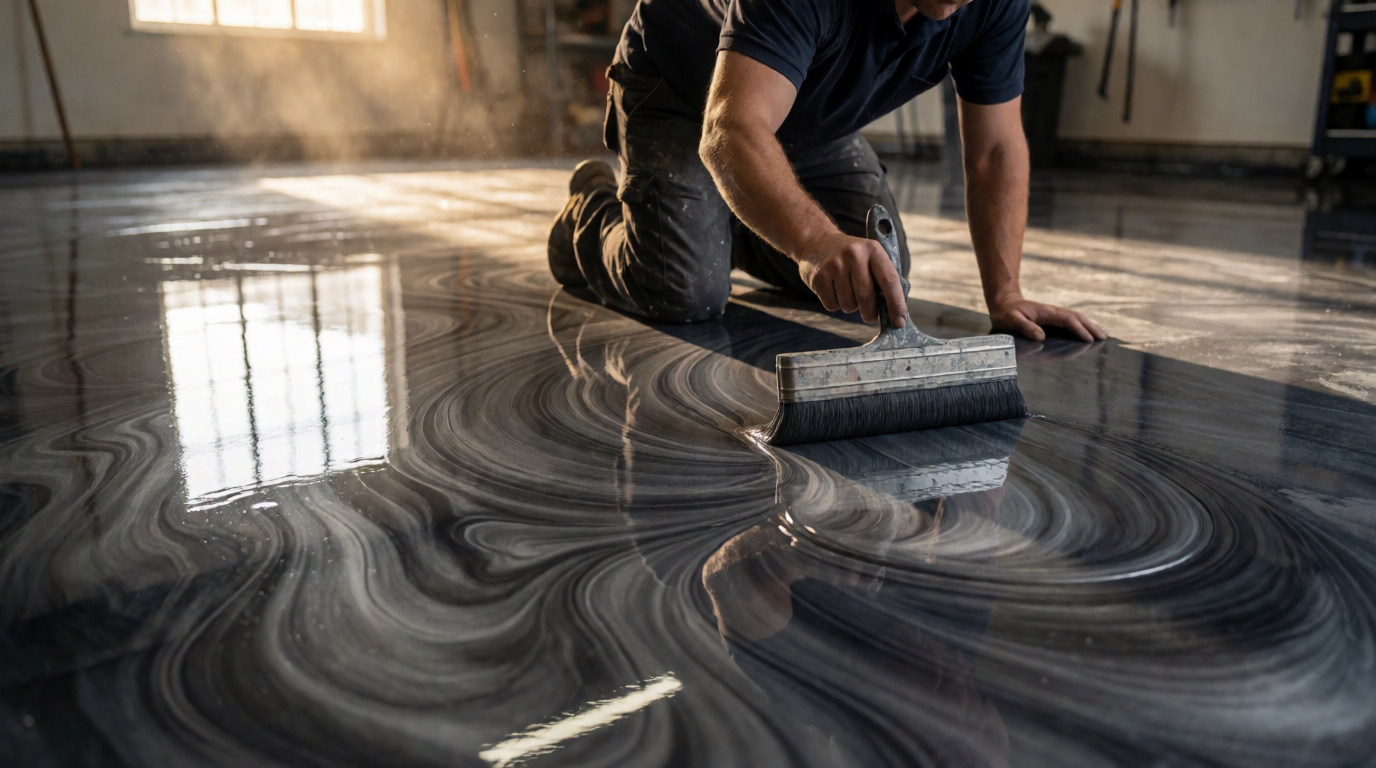
When we execute these projects at World Pro Painting, we utilize a multi-layered approach. We start with a deep mechanical grind to open the "pores" of the concrete. If the concrete is not etched or ground, the epoxy has nothing to grip, which is why so many residential coatings fail. In Hillcrest, where many homes have slabs poured during different eras of construction, the density of the concrete varies, requiring a tailored approach to the priming stage to ensure a permanent bond.
Why Does an Epoxy Coating Matter for Hillcrest Homeowners?
For homeowners in the Hillcrest area of Milpitas, an epoxy floor is not merely an aesthetic upgrade; it is a protective barrier against the unique environmental stressors of the South Bay. The primary reason this matters is the elimination of "concrete dusting." Raw concrete is porous and constantly sheds a fine white powder that settles on your cars and belongings. By sealing this surface, you create a sterile, easy-to-clean environment that increases the property value of your home.
According to the Painting Contractors Association (PCA), professional-grade epoxy coatings can increase the lifespan of a concrete slab by preventing the penetration of automotive fluids, oils, and road salts that otherwise cause chemical erosion. In Milpitas, where many residents commute via the 880 or 680 corridors, the salt and grime brought into the garage during winter rains can degrade untreated concrete over time. A high-solids epoxy system acts as an impermeable shield.
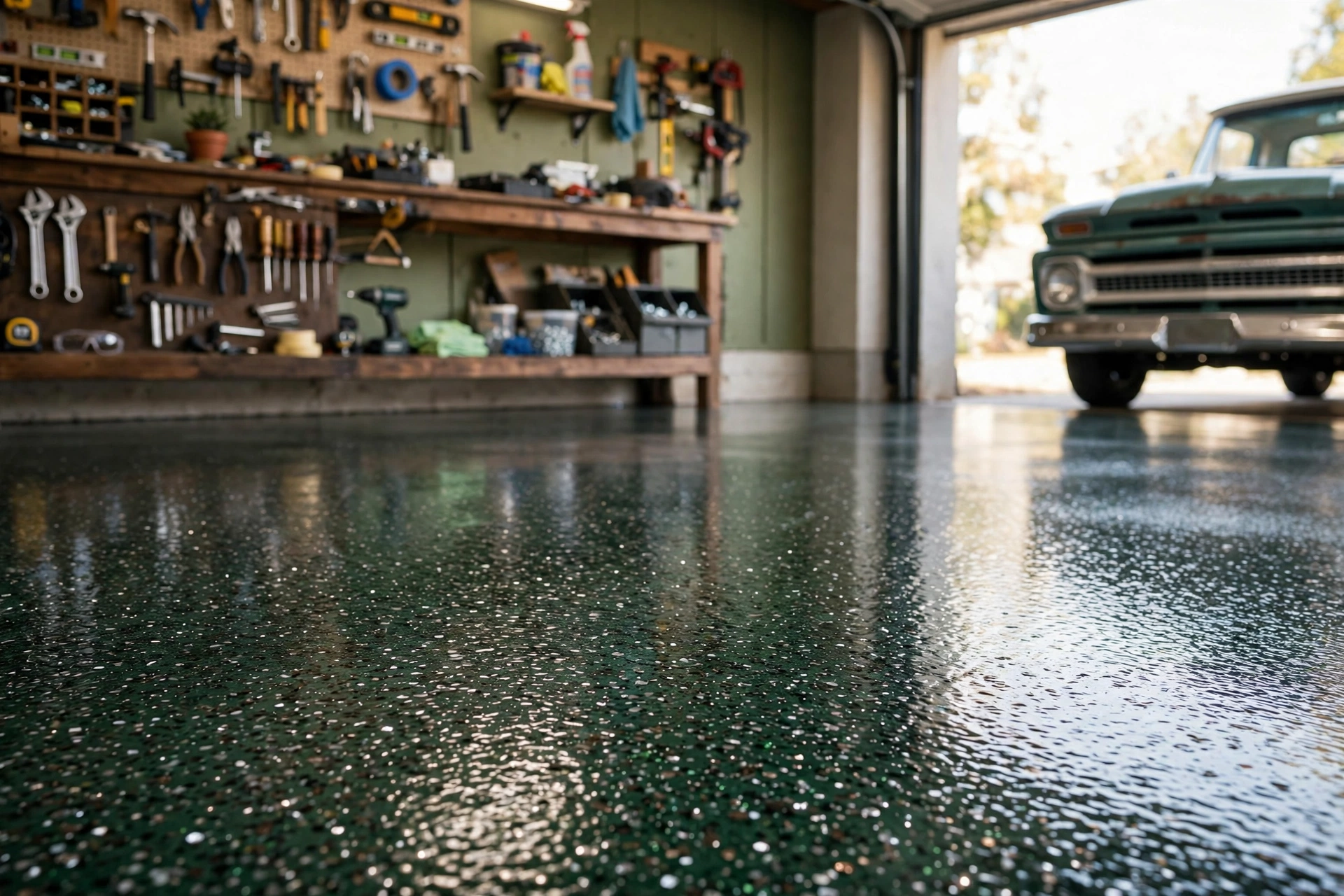
Furthermore, the safety implications are significant. Professional epoxy systems often incorporate slip-resistant additives. In my experience working with residential properties in the Bay Area, I've found that the integration of aluminum oxide or quartz flakes not only provides a modern look but prevents dangerous slips during the rainy season. This level of durability is far superior to the thin-film coatings found in retail stores, which lack the thickness to withstand the shearing force of a turning car tire.
Integrating these floors also complements broader home improvement strategies. A clean, white-flake epoxy floor reflects more light, effectively brightening the garage and making it a usable extension of the home for workshops or gym equipment. This transition from a "storage cave" to a "functional room" is a major trend in 2026 interior design for the Milpitas region.
How to Install Professional Epoxy Flooring in Milpitas
Achieving a floor that lasts a decade requires a rigorous 5-step preparation and application process. You cannot simply "roll on" epoxy and expect professional results. The secret to a failure-free floor in Hillcrest is the preparation of the substrate.
- Mechanical Surface Preparation: We utilize diamond grinding or shot-blasting to remove the "laitance" (the weak top layer of concrete). This creates a CSP (Concrete Surface Profile) of 2-3, which is the industry standard for maximum adhesion. Without this, the epoxy will peel in sheets.
- Moisture Testing and Patching: We test for moisture vapor transmission. If the slab is too damp, we apply a moisture-blocking primer. All cracks are routed out and filled with a high-strength epoxy filler to ensure a seamless finish.
- Priming: A low-viscosity epoxy primer is applied to penetrate deep into the concrete. This ensures that the subsequent layers have a solid foundation and prevents air bubbles (outgassing) from forming in the final coat.
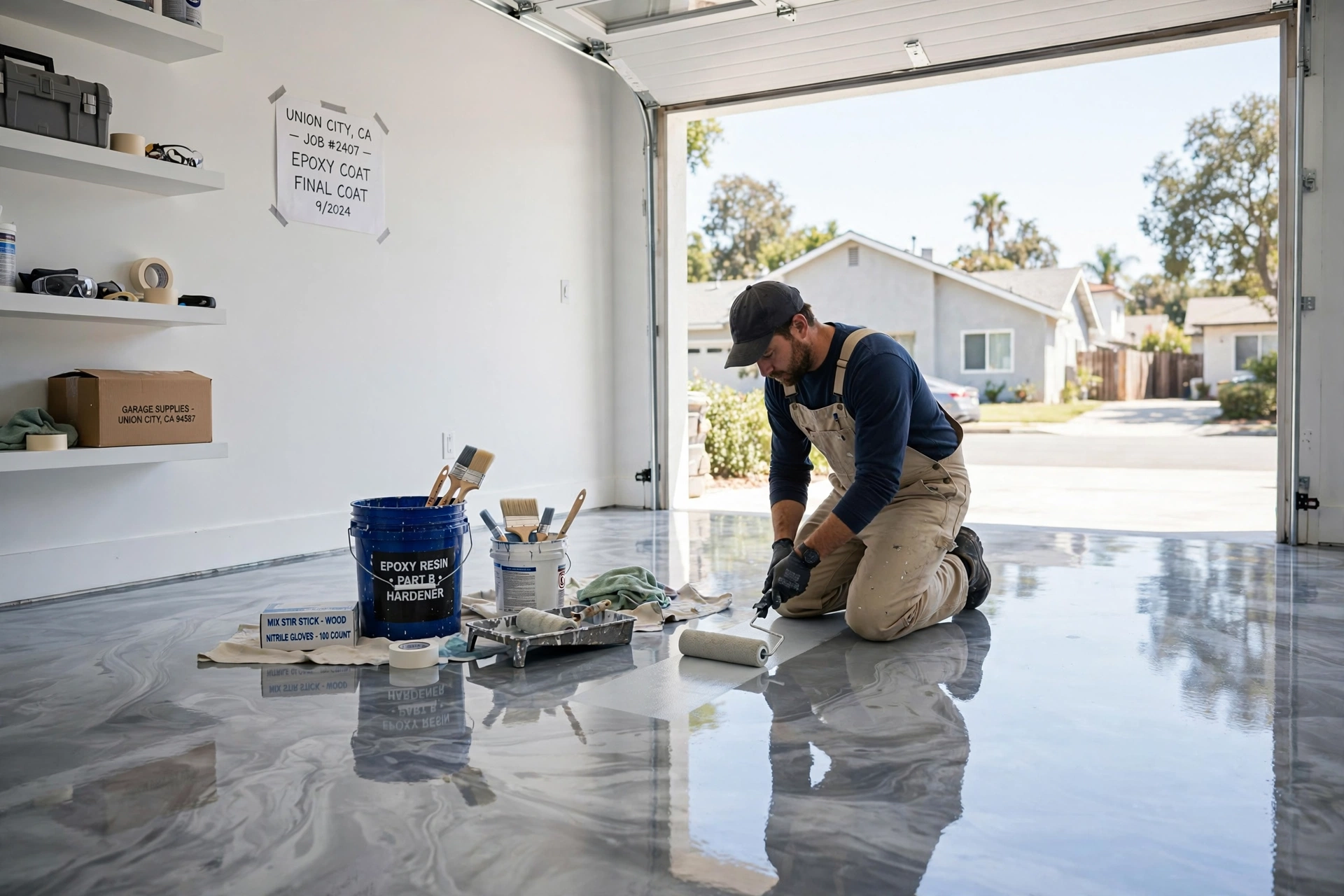
- Base Coat and Broadcast: The primary build coat is applied. While still wet, we broadcast decorative flakes or quartz. This is not just for looks; the flakes provide structural reinforcement and hide imperfections in the concrete.
- Top Coat Application: A high-performance polyurethane or clear epoxy topcoat is applied. This layer provides the UV resistance and chemical protection necessary to prevent the floor from yellowing under the California sun.
For those managing larger properties, this process is similar to the rigor we apply to commercial painting in Cabrillo Fremont, CA, where durability is non-negotiable. By adhering to these technical standards, World Pro Painting ensures that the floor can withstand hot-tire pickup—a common failure point where heat from tires causes cheap coatings to lift.
Epoxy vs. Traditional Concrete Sealers
Many homeowners confuse epoxy with simple concrete sealers or acrylic stains. While sealers protect against water, they do not provide the structural hardness or chemical resistance of a full epoxy system. The difference is the difference between a "skin" and a "shield."
| Feature | Traditional Sealer | Cheap DIY Epoxy Kits | World Pro Painting System |
|---|---|---|---|
| Bond Type | Surface penetration | Weak chemical bond | Deep mechanical bond |
| Thickness | Very Thin | 4-8 mils | 20-40 mils |
| Durability | Low (peels easily) | Moderate (flakes off) | High (6-Year Guarantee) |
| Chemical Resistance | Low | Moderate | High (Oil/Acid Proof) |
| Lifespan | 1-3 Years | 2-5 Years | 10-15+ Years |
As noted by Sherwin-Williams, industrial-grade coatings are formulated with higher solids content, meaning less solvent evaporates and more protective material remains on the floor. This is why professional installations feel "thick" and rubberized compared to the thin, plastic-like feel of a DIY kit. If you are considering the long-term value of your Hillcrest property, the initial investment in a professional system avoids the cost of stripping and reapplying a failed DIY product every few years.
Common Mistakes to Avoid During Garage Flooring
In my experience, the most expensive mistake a homeowner can make is choosing the cheapest bid. Low-cost contractors often skip the grinding phase and use "acid etching," which is often insufficient for the dense concrete found in Milpitas homes. Acid etching only cleans the surface; it doesn't create the mechanical profile needed for a permanent bond.
Another critical error is ignoring the EPA's guidelines if your home was built in an era where lead-based paints might be present on the lower walls or trim near the floor. Proper containment and cleanup are essential during the grinding process to ensure no contaminants are spread throughout the house.
Avoid these common pitfalls:
- Applying over damp concrete: If you see dark spots on your floor, you have moisture issues. Applying epoxy over moisture leads to osmotic blistering.
- Ignoring the "Pot Life": Epoxy has a strict window of workability. If a contractor isn't using a professional team to spread the material quickly, the epoxy will begin to cure in the bucket, leading to streaks and uneven patches.
- Using the wrong topcoat: Pure epoxy yellows when exposed to UV light. In the sunny Bay Area, a polyurethane topcoat is essential for color stability.
For those living in high-density areas, like those seeking house painters in Weibel Fremont, CA, it's important to ensure the contractor is licensed and bonded. Working with a CSLB-licensed contractor like World Pro Painting (License #1142478) ensures that you are protected and that the work meets California's stringent building and safety codes.
Best Practices for Epoxy Maintenance
Once your Hillcrest garage has been coated, the goal is to maintain that "showroom" finish. While epoxy is incredibly durable, it is not indestructible. The most important rule is to avoid using harsh acid-based cleaners which can dull the polyurethane topcoat over time.
💡
Key Takeaway
The best way to maintain an epoxy floor is a weekly sweep with a soft-bristle broom and an occasional mop with a pH-neutral cleaner.
Avoid dragging heavy metal objects across the floor. While the coating is hard, a sharp piece of metal can gouge the surface. If you have a heavy workbench, use rubber mats underneath the legs to distribute the weight. Also, be mindful of "hot tire pickup." While our professional systems are designed to resist this, allowing your car to cool slightly before parking on a brand-new floor (during the first 7 days of curing) can help the bond set perfectly.
If you are also renovating other areas of your home, we recommend coordinating your floor coatings with other services like exterior painting in Lakeside Newark, CA to ensure a cohesive property upgrade. A unified approach to home improvement not only saves on mobilization costs but ensures that the aesthetic of your garage matches the updated look of your home's exterior.
Frequently Asked Questions
How long does epoxy garage floor coating take to cure in Milpitas?
In the California Bay Area climate, most epoxy floors are walkable within 24 hours. However, a full chemical cure—the point where the floor reaches maximum hardness and is ready for heavy vehicle traffic—typically takes 7 days. We advise Hillcrest homeowners to avoid parking cars on the surface for at least 5 to 7 days to prevent "hot tire pickup," where the heat from tires can pull the coating away from the concrete if it hasn't fully cross-linked.
Will epoxy flooring crack if my garage slab already has cracks?
Epoxy does not stop a slab from cracking further if the house is settling, but it does prevent moisture from entering those cracks. Our process involves "routing" the cracks—widening them slightly—and filling them with a flexible epoxy joint filler. This ensures that the surface remains seamless and waterproof. While the coating follows the movement of the slab, our professional-grade materials are designed to be flexible enough to resist cracking under normal thermal expansion.
Is epoxy better than painting the garage floor?
Yes, exponentially. Paint is a topical coating that peels, chips, and wears thin within a year. Epoxy is a chemical bond that creates a new, hard surface. According to the California Contractors State License Board (CSLB), professional installations are recognized as structural improvements. Epoxy is impervious to oil and gasoline, whereas paint will dissolve or stain immediately upon contact with automotive fluids.
Can you apply epoxy over an old painted floor?
Only if the old paint is completely removed. We cannot apply epoxy over existing paint because the epoxy will bond to the paint, and the paint will peel from the concrete, causing the entire epoxy floor to fail. We use professional diamond grinders to strip the floor down to raw concrete. This is a non-negotiable step in our process at World Pro Painting to ensure the 6-year guarantee we provide to our Milpitas clients.
How do I know if my concrete is too damp for epoxy?
We use a calcium chloride test or a digital moisture meter to measure the moisture vapor emission rate (MVER). If the concrete is too damp, we apply a specialized moisture-mitigating primer. This primer creates a barrier that prevents water vapor from pushing the epoxy off the floor. This is especially common in older Hillcrest homes where the vapor barrier beneath the slab may have degraded over several decades.
Conclusion
Investing in a professional epoxy garage floor coating in Hillcrest, Milpitas, is the most effective way to protect your home's foundation while creating a clean, professional environment. From eliminating concrete dust to preventing chemical erosion, the benefits of a high-solids epoxy system far outweigh the temporary fix of a DIY kit. By focusing on mechanical preparation and using industrial-grade materials, World Pro Painting delivers a surface that withstands the rigors of Bay Area living.
Whether you are looking to increase your home's resale value or simply want a garage that is easier to clean, the right coating makes all the difference. For those exploring other options, we also provide expert house painting in Niles Fremont, CA to ensure your entire property is protected and polished. Don't risk your investment with an unlicensed contractor; choose the authority in Bay Area coatings.
Ready to transform your garage into a durable, high-performance space? For a comprehensive overview and to schedule your free on-site estimate, visit our guide on epoxy garage floor coating hillcrest milpitas. Let World Pro Painting provide the quality and durability your Hillcrest home deserves.
Commercial Painting Cost Calculator & Color Guide
Get an instant estimation checklist for painting your office, warehouse, or house. Learn how to choose colors that boost productivity.