

📖This article is part of the complete guide to Epoxy Garage Floor Coating.
In my experience working with luxury estates in the Hayward Hills area, I have seen a recurring tragedy: homeowners investing in high-end architectural finishes but leaving their garages as raw, porous concrete. Concrete is an absorbent sponge; it pulls in oil, road salt, and moisture, leading to permanent staining and structural degradation over time. In 2026, the standard for home improvement in the East Bay has shifted toward industrial-grade durability that doesn't sacrifice aesthetics. For a comprehensive overview of the process, explore our guide on epoxy garage floor coating hayward hills hayward.
What is Epoxy Garage Floor Coating in Hayward Hills, Hayward?
📚
Definition
Epoxy garage floor coating is a thermosetting resin polymer that creates a hard, durable, and chemically resistant plastic surface when applied to concrete. Unlike standard paint, epoxy forms a chemical bond with the concrete substrate, essentially becoming part of the floor.
Epoxy garage floor coating in Hayward Hills, Hayward is a specialized surfacing system designed to protect residential garage slabs from the unique environmental stressors of the East Bay. When we apply these systems at World Pro Painting, we aren't just "painting" a floor; we are engineering a surface. The process involves a two-part system: a resin and a hardener. When these two components are mixed, a chemical reaction occurs that transforms the liquid into a rigid, waterproof shield.
In the hills of Hayward, the terrain often leads to more moisture seepage and runoff entering the garage. A professional epoxy coating seals these pores, preventing moisture from migrating upward through the slab, which is a common cause of peeling in cheap DIY kits. High-quality epoxy systems used by licensed contractors are significantly thicker than retail-grade products, typically ranging from 100% solids epoxy to polyaspartic hybrids. This thickness is what allows the floor to withstand the weight of heavy SUVs and the friction of tires without chipping or delaminating.
Why Does Epoxy Flooring Matter for Hayward Hills Homeowners?
Investing in a professional epoxy surface is essential because raw concrete in the California Bay Area is prone to "dusting"—a process where the top layer of concrete continually breaks down into a fine powder. This dust permeates the entire home, settling on cars and storage items. By implementing a professional coating, homeowners eliminate this phenomenon entirely, creating a hygienic environment that is easy to clean.
According to the Painting Contractors Association (PCA), professional-grade coatings can extend the lifespan of a concrete slab by decades by preventing the penetration of chlorides and oils. In Hayward Hills, where many properties feature expansive multi-car garages, the risk of oil leaks and chemical spills is high. A professional epoxy floor prevents these contaminants from soaking into the concrete, meaning a spill that would permanently stain a raw slab can be wiped away with a simple degreaser.
Furthermore, the aesthetic upgrade significantly impacts property value. In a competitive real estate market like the San Francisco Bay Area, a finished, polished garage signals to buyers that the home has been meticulously maintained. It transforms a utility space into a functional extension of the living area, suitable for home gyms or workshops. When we integrate these coatings, we often suggest coordinating the color with the interior design of the rest of the house to create a seamless transition.
For those managing larger projects, it is helpful to understand the broader logistics of hiring California Bay Area painting: scope, timeline & Bay Area project guide to ensure your garage upgrade aligns with other home improvements.
How to Properly Install Epoxy Coating in Hayward Hills?
Installing a lasting epoxy floor is 90% preparation and 10% application. If the surface isn't prepared, the epoxy will peel regardless of the brand. At World Pro Painting, we follow a rigorous 5-step industrial protocol to ensure a lifetime bond.
First, we perform a mechanical etch or diamond grinding. This is the most critical step. We remove the "laitance" (the weak top layer of concrete) to open the pores of the slab. Without this, the epoxy sits on top of the concrete rather than bonding inside it. In my experience, most DIY failures in Hayward Hills happen because the homeowner relied on a simple acid wash, which is insufficient for the heavy-duty slabs found in modern hillside homes.
Second, we execute deep cleaning and crack repair. We use industrial vacuums to remove every speck of dust, then fill cracks with a specialized epoxy filler. This ensures the final surface is perfectly flat and monolithic. Third, we apply a high-quality primer. This acts as the glue between the concrete and the main coating, preventing air bubbles (outgassing) from forming as the concrete breathes.
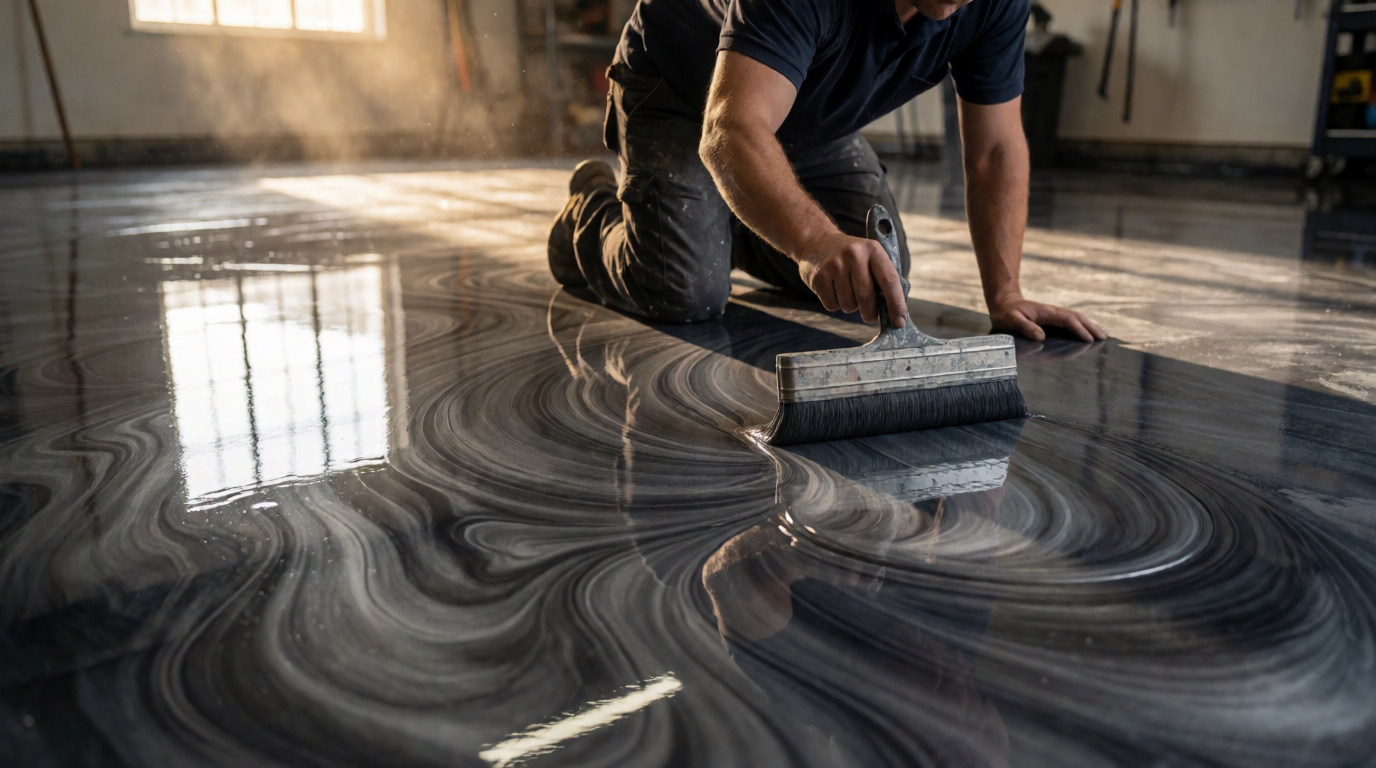
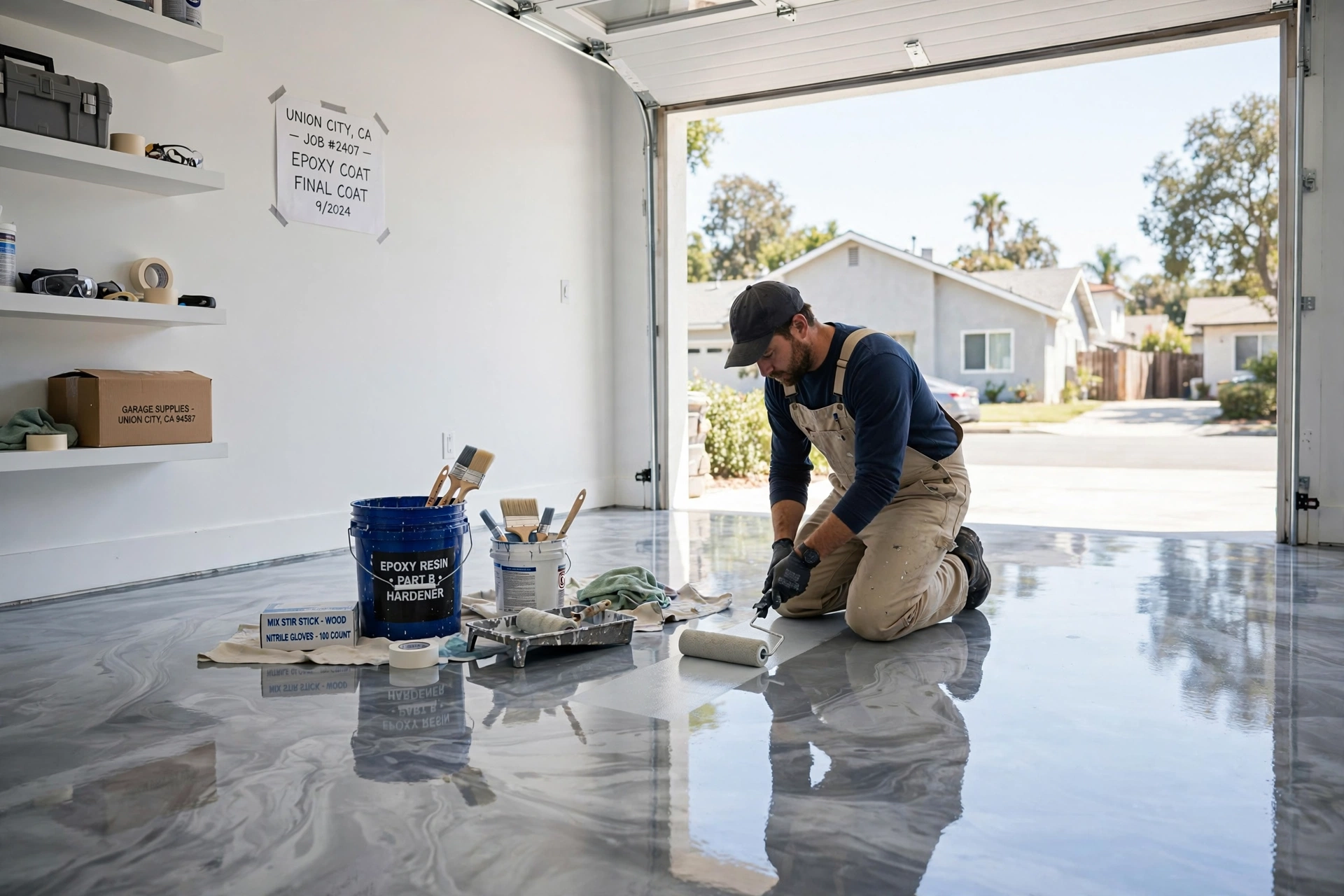
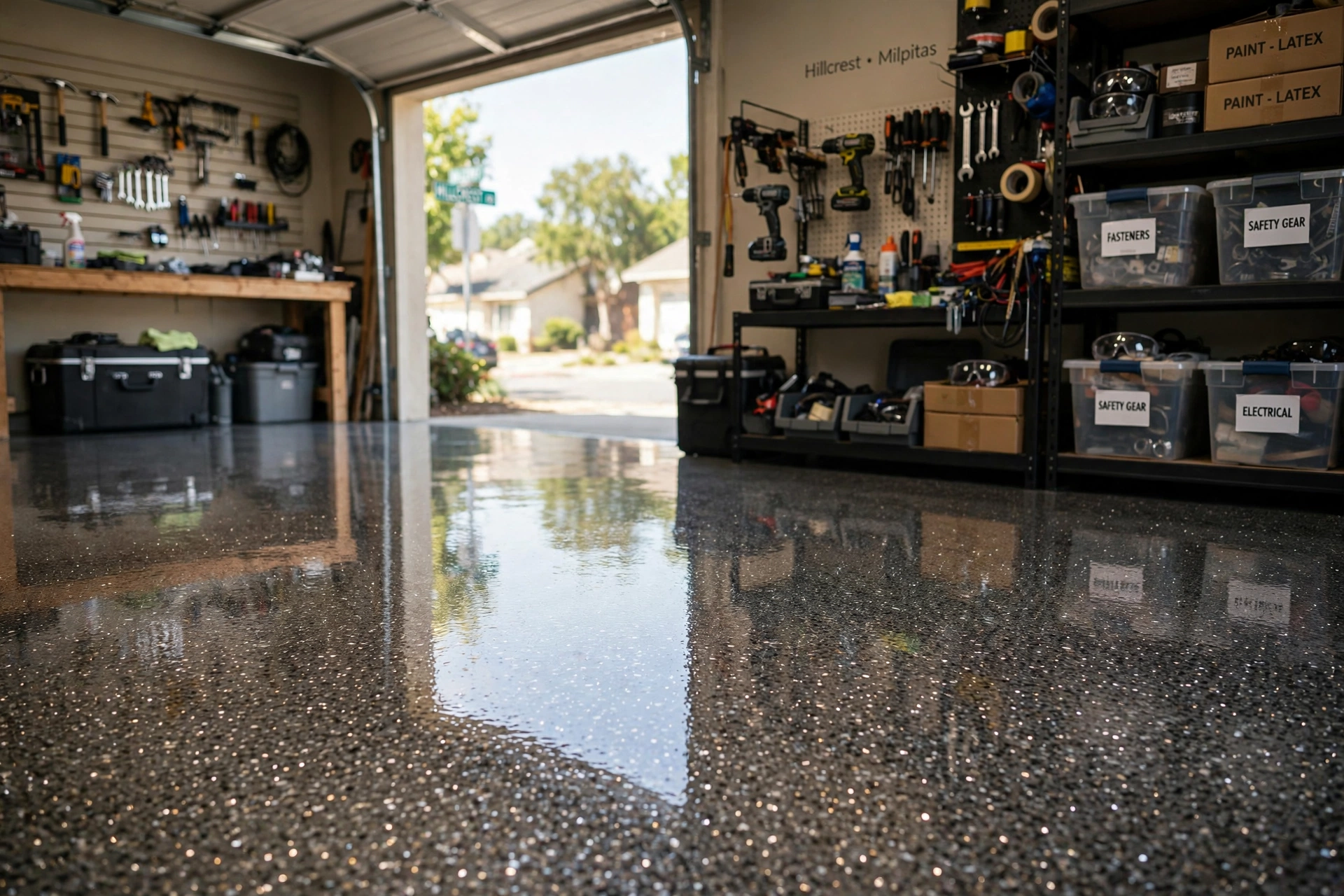
Fourth, the base coat of 100% solids epoxy is applied. We use a squeegee and roller system to ensure an even thickness across the entire garage. Fifth, we integrate a decorative flake or a clear topcoat. For homes in the Bay Area, we often recommend a polyaspartic topcoat over the epoxy. This is because polyaspartics are UV-stable; they won't turn yellow when exposed to the California sun streaming into the garage door.
If you are also considering updating the exterior of your home to match your new interior standards, you might look into exterior painting in lakeside Newark, CA to see how high-durability coatings perform in similar climates.
Professional Epoxy vs. DIY Kits vs. Raw Concrete
Many homeowners are tempted by "big box" store epoxy kits. However, these are typically water-based paints with very low solids content, meaning they are thin and prone to "hot tire pickup"—where the heat from your tires literally pulls the paint off the floor.
| Feature | Raw Concrete | DIY Epoxy Kits | World Pro Painting Professional Epoxy |
|---|---|---|---|
| Durability | Low (Cracks/Dusts) | Moderate (Peels quickly) | Maximum (Industrial Grade) |
| Stain Resistance | None (Absorbent) | Low (Stains over time) | Total (Chemical Resistant) |
| Installation | N/A | Fast but risky | Comprehensive & Guaranteed |
| Longevity | Decades (but ugly) | 1-3 Years | 10-20 Years |
| UV Stability | N/A | Poor (Yellows) | High (UV-Resistant Topcoats) |
As the table illustrates, the gap between a DIY kit and a professional installation is vast. A professional system uses 100% solids resin, whereas DIY kits are often 70% solvent. When the solvent evaporates, the remaining layer is too thin to protect the floor.
Common Mistakes to Avoid When Coating Your Garage
The most frequent mistake I see in the Hayward Hills area is the "shortcut" mentality. Homeowners often skip the diamond grinding phase to save time. As a licensed contractor (CSLB #1142478), I must emphasize that the California Contractors State License Board (CSLB) maintains standards for a reason: improper preparation leads to structural failure of the coating.
Another common error is ignoring the moisture content of the slab. In the hills of Hayward, groundwater can seep through the concrete. If you apply epoxy over a damp slab, the moisture will push the coating up, creating blisters and bubbles. We use professional moisture meters to ensure the concrete is dry before a single drop of resin is poured.
Lastly, avoid using the wrong topcoat. Many people use a standard epoxy for the final layer, but epoxy is not UV-stable. If your garage is open or has large windows, the floor will yellow within months. We always recommend a polyaspartic or polyurethane finish for maximum clarity and hardness. This is a level of detail you won't find in a standard house painting mission San Jose Fremont, CA project, but it is vital for floors.
Frequently Asked Questions
How long does it take for epoxy garage floors to fully cure in Hayward Hills?
While you can typically walk on a professional epoxy floor within 24 hours, "full cure" takes significantly longer. For a standard industrial installation, we recommend waiting 3 to 7 days before parking a vehicle on the surface. This allows the chemical cross-linking of the resins to reach maximum hardness. If you park too early, the heat from the tires can cause the coating to soften or imprint, a phenomenon known as hot tire pickup. In the humid coastal influence of the Bay Area, curing times may vary slightly based on the temperature and humidity levels during application.
Does epoxy flooring increase the resale value of a home in the Bay Area?
Yes, absolutely. In the high-end markets of Hayward Hills and surrounding areas, a professional epoxy floor is viewed as a luxury upgrade rather than a basic utility. It transforms the garage from a dirty storage area into a clean, showroom-like space. Real estate agents often note that finished garages improve the overall "perceived quality" of the home. Because it reduces dust and increases the lifespan of the concrete, it is a tangible asset that buyers value, especially those looking for a turnkey property in the California Bay Area.
Can you apply epoxy over a floor that already has a cheap DIY coating?
It is possible, but it requires a complete removal of the old product. You cannot simply paint new epoxy over an old, peeling DIY kit. If you do, the new coating will only be as strong as the old one; when the old paint fails, the new epoxy will peel away with it. We use industrial grinders to strip the floor back to raw, virgin concrete. This process ensures a clean surface for a new chemical bond. We recommend this approach for many of our clients in niles Fremont, CA who tried a kit years ago and are now seeking a permanent solution.
Is epoxy flooring slippery when wet, and how do you fix it?
Smooth epoxy can be very slippery when wet, which is a safety concern in a garage. To solve this, we integrate a "non-slip" additive during the final topcoat application. We typically use aluminum oxide or quartz granules that are broadcast into the wet resin. This creates a subtle, sandpaper-like texture that provides excellent grip without making the floor difficult to clean. This is an essential safety requirement for any professional installation, ensuring that your family and guests are safe even if water is tracked in from the Hayward rain.
How do I maintain my epoxy garage floor to make it last 20 years?
Maintenance is remarkably simple compared to raw concrete. Avoid using harsh acids or ammonia-based cleaners, as these can eventually dull the gloss of the topcoat. Instead, use a pH-neutral cleaner and a microfiber mop. For larger areas, a soft-bristle push broom or a vacuum (without a beater bar) works best. We suggest periodically checking for deep gouges—though rare with professional-grade epoxy—and touching them up immediately to prevent moisture from entering the slab. Following these steps ensures your investment remains pristine for decades.
Conclusion
Choosing a professional epoxy garage floor coating in Hayward Hills, Hayward is an investment in both the safety and value of your home. From eliminating concrete dust to creating a chemically resistant shield, the benefits far outweigh the initial cost. By avoiding the pitfalls of DIY kits and ensuring a diamond-ground preparation, you ensure a floor that stands up to the rigors of California living.
Whether you are looking to enhance your home's utility or prepare it for the market, the difference between a "painted" floor and a professionally engineered epoxy system is clear. For more detailed information on the technical specifications and the full process, please refer to our main guide on Epoxy Garage Floor Coating in Hayward Hills, Hayward | Licensed Contractors | World Pro Painting.
Ready to transform your garage into a durable, showroom-quality space? Contact World Pro Painting today for a free on-site estimate. Our CSLB-certified team is ready to provide the expert preparation and premium materials your home deserves.
Commercial Painting Cost Calculator & Color Guide
Get an instant estimation checklist for painting your office, warehouse, or house. Learn how to choose colors that boost productivity.