
📖This article is part of the complete guide to Exterior House Painters.
How Does a Professional Exterior Painting Process Actually Work?
I remember a project in San Francisco a few years back where a homeowner had hired a "budget" crew that simply painted over peeling lead paint and mildew. Within six months, the new coat was bubbling and flaking. This is the most common failure in our industry: skipping the preparation. When homeowners ask how exterior house painters works, they are often looking for a price, but what they actually need to understand is the rigorous sequence of surface stabilization and chemical bonding that prevents a paint job from failing in the harsh Bay Area climate.
A professional exterior painting process is not about the act of applying color; it is about the science of substrate preparation. It works by systematically removing unstable layers, neutralizing contaminants, and applying a multi-stage coating system—primer, mid-coat, and topcoat—that seals the home against moisture and UV degradation. For those managing larger properties, such as those seeking Multi-Family Painters in Weibel - Fremont, CA, this process must be scaled to ensure consistency across multiple units while adhering to strict safety standards.
The Science of Substrate Preparation and Coating
To understand the technical side of how exterior house painters works, we must first define the foundation of the project. Painting is essentially the application of a protective membrane over a building's "skin." If that skin is dirty, damp, or crumbling, the membrane will fail.
📚
Definition
Substrate is the underlying surface (wood, stucco, brick, or siding) that is being painted. The "bond" refers to the chemical and mechanical adhesion between the substrate and the paint film.
In my experience working with Victorian-era homes in San Francisco and modern builds in San Jose, the most critical phase is the "cleaning and stabilization" stage. We don't just "wash" a house; we perform a targeted decontamination. This involves removing oxidation from siding and neutralizing efflorescence (the white salty powder) on stucco. According to the Painting Contractors Association (PCA), proper surface preparation is the single most important factor in determining the longevity of a coating, as paint cannot adhere to loose particles or oils.
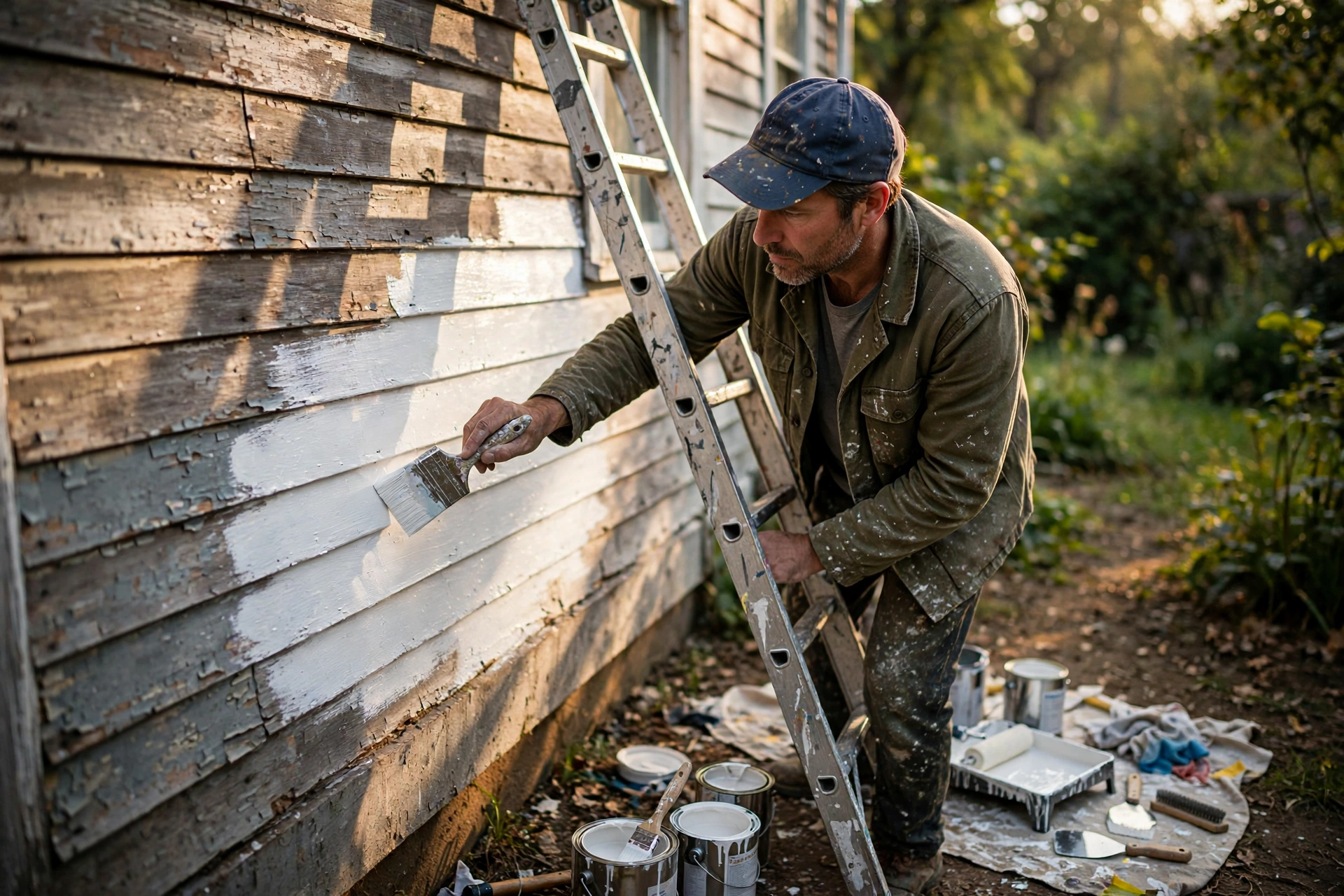
The process begins with a thorough assessment. We look for "alligatoring" (cracks that look like reptile skin) and "chalking" (where the paint has broken down into a powder). If we simply paint over these, the new layer will pull the old, failing paint off the wall. Professional painters use high-pressure washing—calibrated to avoid damaging the wood—to remove organic growth and dirt. Once dry, we move to scraping and sanding. This isn't just about aesthetics; it's about creating a "profile" or a microscopic texture that allows the primer to "bite" into the surface.

Why Professional Process Implementation Matters for Property Value
Skipping a single step in the professional painting sequence doesn't just result in a "less pretty" house; it leads to structural decay. In the California Bay Area, we deal with extreme microclimates. A home in Pacifica faces constant salt-air corrosion and moisture, while a home in the Tri-Valley area faces intense UV radiation and heat.
When a professional follows the correct sequence, they are installing a barrier. According to data from the Environmental Protection Agency (EPA), especially in older Bay Area neighborhoods, the identification and stabilization of lead-based paint are not just quality issues but legal requirements. Failure to use RRP-certified (Renovation, Repair, and Painting) protocols can lead to massive fines and health risks for the inhabitants.
From a financial perspective, a professional paint job provides one of the highest ROIs in home improvement. However, this ROI is only realized if the paint lasts. A "cheap" job that lasts two years is significantly more expensive than a premium job that lasts ten. When we analyze the cost over a decade, a professional process—which includes high-end products from Sherwin-Williams or Benjamin Moore—reduces the lifetime cost of maintenance by nearly 40%.
The consequence of an improper process is "intercoat failure." This happens when the primer and the topcoat are chemically incompatible, or when the paint is applied during a window of high humidity (common during SF's "June Gloom"). This leads to peeling, which allows water to seep into the wood, causing dry rot and termite infestations. For those coordinating Exterior Painting in Lakeside, Newark, CA: for 2026, ensuring the contractor follows a documented preparation checklist is the only way to guarantee the warranty.
Practical Application: The World Pro Painting 5-Step Process
If you want to know exactly how we execute a project at World Pro Painting, it follows a clinical, non-negotiable sequence. We don't cut corners because the Bay Area weather will find every single one of them within twelve months.
Step 1: Power Washing and Decontamination
We remove all loose debris, cobwebs, and mildew. We use specialized cleaning agents to kill mold spores rather than just rinsing them away. This ensures that we aren't trapping fungus under a new layer of paint.
Step 2: Mechanical Surface Preparation
This is where the "real" work happens. We scrape every loose flake of paint and sand the edges of the remaining paint to create a smooth transition (feathering). This prevents "paint lines" from showing through the final coat.
Step 3: Caulking and Gap Sealing
We apply high-grade elastomeric sealant to all joints, window frames, and door trim. This stops water from entering the structure. Many contractors use cheap acrylic caulk that shrinks and cracks in the sun; we use materials that expand and contract with the house.
Step 4: Priming and Spot Treatment
We don't just prime everything; we prime strategically. We use oil-based primers on raw wood to block tannins (those brown stains that bleed through) and high-adhesion primers on glossy surfaces. This acts as the "glue" between the house and the paint.
Step 5: Precision Topcoating
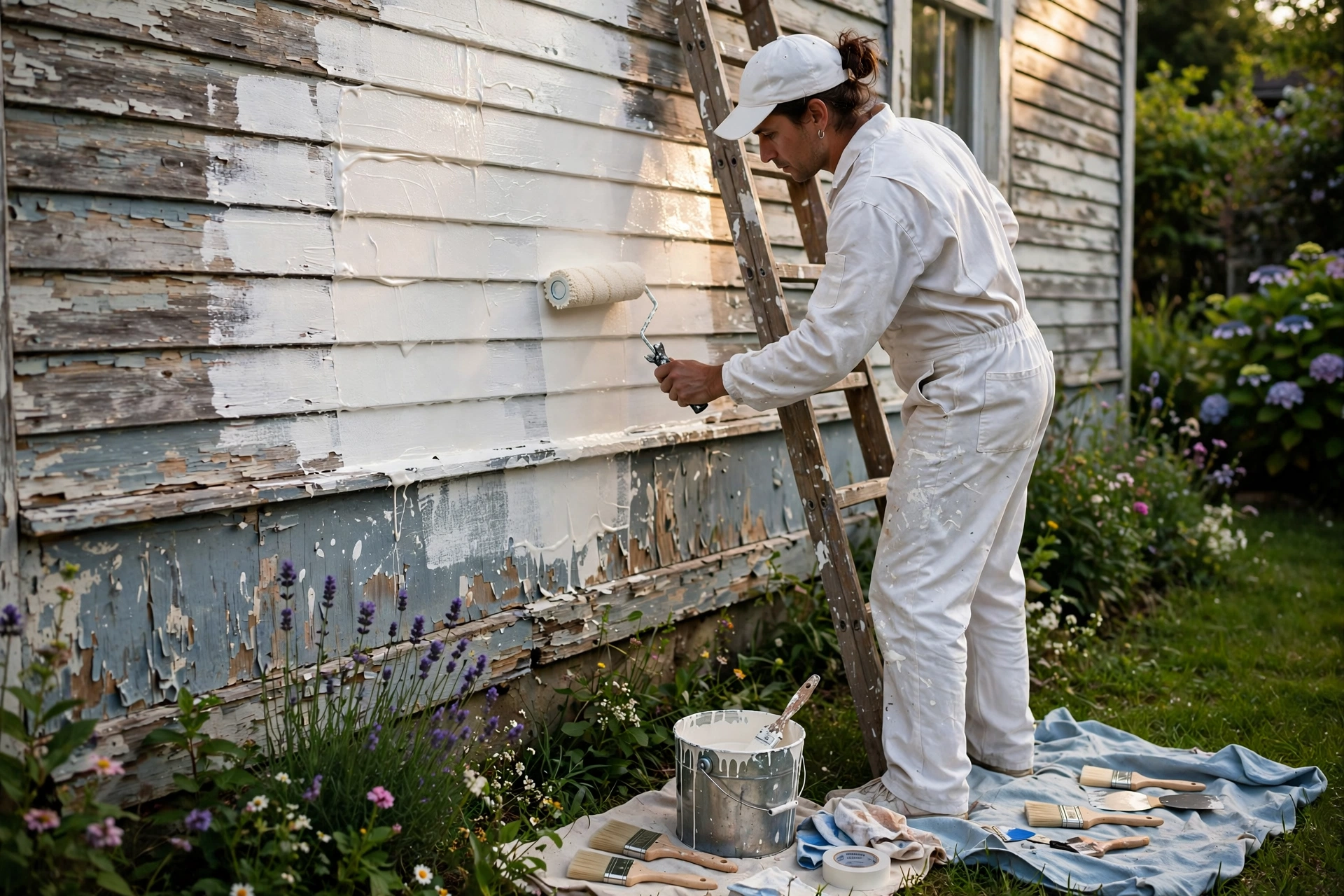
We apply two coats of premium exterior paint. We use a combination of spraying for a uniform finish and "back-brushing" to push the paint into the pores of the wood. This ensures 100% coverage and maximum durability.
💡
Key Takeaway
The "painting" part of a professional job is only about 20% of the labor. The other 80% is cleaning, scraping, sanding, and sealing. If a contractor spends most of their time with a brush in hand and very little time with a scraper, they aren't doing a professional job.
For those managing complex sites, such as Commercial Painting Cabrillo - Fremont, CA 2026, we adapt this process to include industrial-grade coatings that can withstand high foot traffic and environmental pollutants.
Comparing Painting Approaches: Budget vs. Professional
The biggest misconception homeowners have is that "paint is paint." In reality, the difference lies in the chemistry of the product and the discipline of the application.
| Feature | The "Budget" Approach | Generic AI/DIY Approach | The World Pro Painting Approach |
|---|---|---|---|
| Preparation | Quick rinse or no wash | Basic scraping, no sanding | Power wash, scrape, sand, caulk, prime |
| Materials | Lowest cost contractor grade | Mixed brands, inconsistent quality | Premium Sherwin-Williams/Benjamin Moore |
| Technique | Single coat, heavy drips | Over-application, unevenness | Two-coat system with back-brushing |
| Warranty | Verbal "it'll be fine" | None or very limited | 6-Year Guarantee |
| Best For | Flipping a house in 3 months | Very small touch-ups | Long-term home protection & value |

As you can see, the "Budget" approach is actually a liability. Using a low-quality paint on a poorly prepared surface is essentially painting a timer on your wall—you are just waiting for the moment it begins to peel. For larger residential complexes, like those needing Multi-Family Painters Brookvale - Fremont, CA, the risk is multiplied because a failure in one unit often indicates a systemic failure across the entire property.
Common Questions and Misconceptions
Most "how-to" guides on the internet get the process wrong because they focus on the color and not the chemistry. Here are the most common myths I encounter in the field.
Myth 1: "You don't need primer if you're using a Paint-and-Primer-In-One."
This is a dangerous half-truth. These products are great for refreshing a wall that is already in good condition. However, they lack the penetration power of a dedicated primer. If you have raw wood, rusted metal, or peeling paint, a "combined" product will not bond correctly. It’s like trying to glue two pieces of sandpaper together without any actual glue.
Myth 2: "Pressure washing is always the best way to clean."
Too much pressure can actually destroy your substrate. In my experience, I've seen "pros" blow holes right through old cedar siding or strip the lime from stucco. The goal is decontamination, not demolition. We calibrate our PSI based on the material—low for old wood, medium for stucco, and high for concrete.
Myth 3: "Darker colors protect the house better because they absorb more heat."
Actually, darker colors often fade faster because they absorb more UV radiation, which breaks down the chemical bonds of the paint. This is why we often recommend specific UV-resistant lines for the sunny side of a home. For those looking at Exterior Painting in Birch Grove, Newark, CA (2026), choosing a color that balances aesthetics with UV reflectance is key to longevity.
Frequently Asked Questions
How long does a professional exterior paint job actually take?
A high-quality job for an average-sized Bay Area home typically takes 7 to 14 days. This timeline is necessary because each stage—washing, drying, scraping, priming, and painting—requires specific environmental conditions. For example, if we apply primer to damp wood, it will trap moisture and cause the paint to bubble. We monitor the humidity and surface moisture levels daily. If we rush this process, we compromise the 6-year guarantee we provide to our clients.
Why is professional painting so much more expensive than a handyman's quote?
The price difference is almost entirely in the labor of the preparation phase. A handyman typically quotes for the "painting" part: the hours spent applying the color. A professional quote includes the hours spent on the "invisible" work: the sanding, the caulking of every single gap, and the multi-stage priming. Furthermore, we use licensed professionals who carry insurance and bonding, as verified by the California Contractors State License Board (CSLB), which protects the homeowner from liability.
What is the best time of year to paint a house in the Bay Area?
While painting is possible year-round, the ideal window is late spring through early autumn. The key is avoiding the "dew point"—the temperature at which water vapor condenses into liquid. In San Francisco, the coastal fog can keep surfaces damp long after the sun comes out. We track these patterns to ensure the substrate is completely dry before applying the first coat. If you are planning Multi-Family Painters Mission San Jose - Fremont, CA projects, scheduling during the dry months prevents the "trapped moisture" failures common in winter jobs.
How do I know if my house needs a full scrape or just a fresh coat?
If you can peel a piece of paint off with your fingernail, a fresh coat will not fix it. Paint is a film; if the film is detached from the wall, any new paint applied on top will simply pull the old film away, leading to immediate peeling. We perform a "tape test" where we apply a strong adhesive strip to a suspect area; if the paint comes off with the tape, the surface requires mechanical scraping and stabilization. This is a core part of How to Use California Bay Area Painting standards.
Does the type of paint really change how the process works?
Absolutely. Oil-based paints are superior for blocking stains and priming raw wood, but they break down under UV light and can yellow over time. Acrylics (latex) are more flexible and breathable, which is essential for the expanding and contracting of wood in the California heat. A professional process uses a "layered" strategy: an oil-based primer for stability and an acrylic topcoat for durability. Using only one type of product for everything is a recipe for premature failure.
Final Thoughts on How Exterior House Painters Works
Understanding how exterior house painters works allows you to move beyond the "lowest bid" mentality and focus on the "lowest lifetime cost." The secret to a beautiful home isn't the color of the paint; it's the discipline of the preparation. By prioritizing a 5-step process of decontamination, stabilization, sealing, priming, and precision coating, you protect your home from the elements and significantly increase its market value.
Whether you are managing a single residence or a large complex, the goal is always the same: creating a permanent, waterproof seal that looks flawless. At World Pro Painting, we bring this level of clinical precision to every project across the Bay Area.
If you're tired of seeing your paint peel every few years, it's time to stop painting and start protecting. Experience the difference that expert preparation makes.
Ready to protect your investment?
Visit worldpropainting.com to schedule your Free On-Site Estimate and ensure your home is prepared for the 2026 season.
Commercial Painting Cost Calculator & Color Guide
Get an instant estimation checklist for painting your office, warehouse, or house. Learn how to choose colors that boost productivity.