Which Coating Should You Choose: Polyaspartic vs. 100% Solids Epoxy for Bay Area Garages?
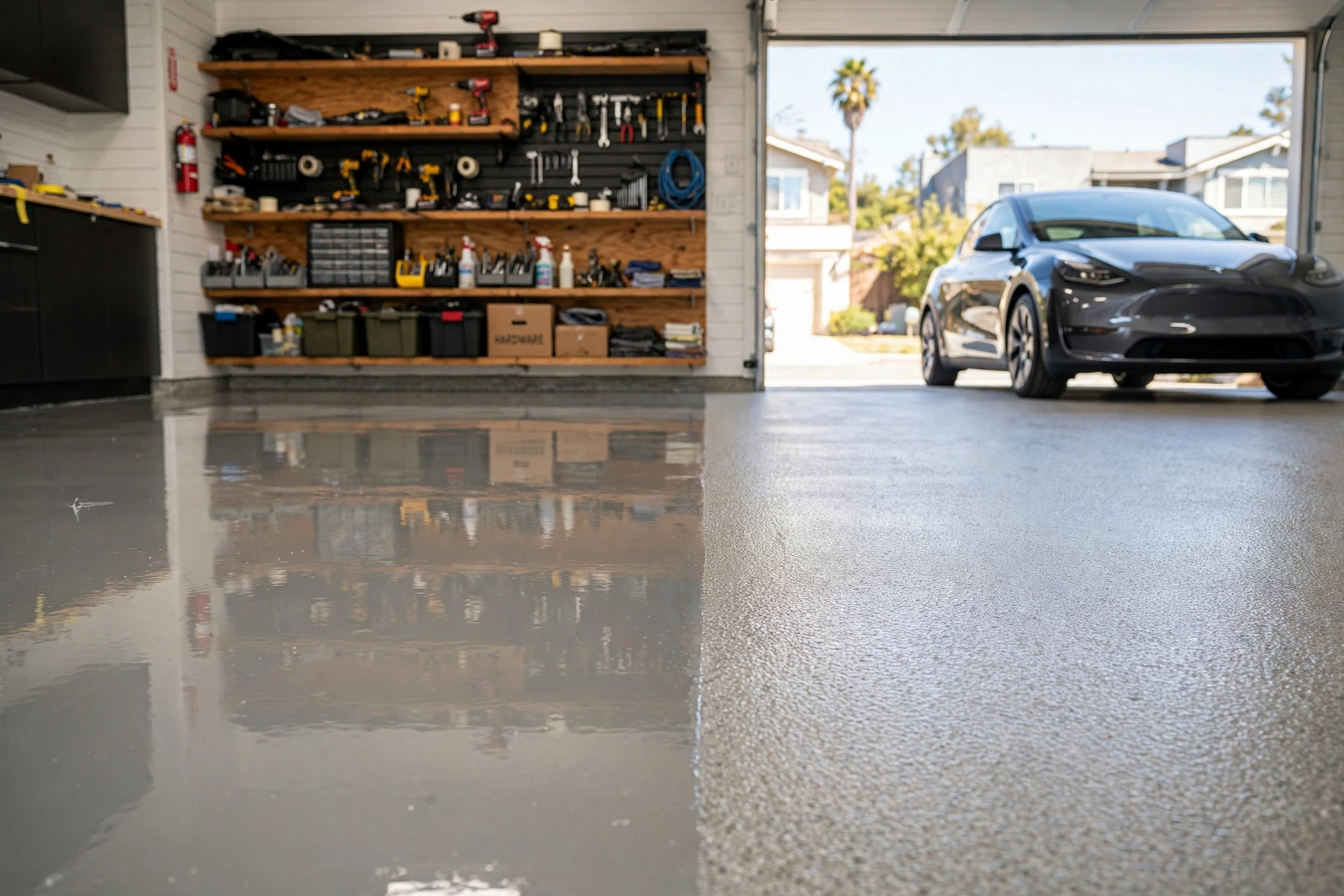
Choosing between polyaspartic and epoxy often comes down to how much time you can afford to lose and how much sunlight your garage floor actually sees. While many homeowners search for Epoxy Garage Floor Installers Bay Area assuming epoxy is the gold standard, the reality is that polyaspartic coatings offer superior UV stability and a significantly faster return-to-service time. For most high-traffic residential garages in the California Bay Area, polyaspartic is the technically superior choice due to its flexibility and resistance to "ambering" (yellowing) under the intense California sun.
If you need a floor that is rock-hard, chemically resistant, and can be installed in a single day without the risk of hot-tire pickup, polyaspartic is the winner. If you are looking for a deeply saturated, high-gloss aesthetic and have a lower budget with a flexible move-in timeline, 100% solids epoxy remains a viable, durable option. For a comprehensive overview of managing your project, explore our Hiring California Bay Area Painting: Scope, Timeline & Bay Area Project Guide.

What Exactly Are These Coating Technologies?
To make an informed decision, you first have to understand that these are not just "paints" but complex chemical resins that bond with the concrete substrate. When we talk about 100% solids epoxy, we are referring to a material that contains no solvents, meaning no chemicals evaporate during the curing process. This results in a thicker, more durable film than the cheap DIY kits found at big-box stores.
📚
Definition
100% Solids Epoxy is a high-performance resin consisting of a resin and a hardener that creates a dense, non-porous surface with zero volatile organic compounds (VOCs) evaporating during the cure.
Polyaspartic, on the other hand, is a member of the polyurea family. It is a "rapid-cure" technology. While epoxy takes days to fully cure, polyaspartic can be driven on in as little as 24 hours. The chemical structure of polyaspartic is more flexible than epoxy, which is a critical detail for the Bay Area. Because our region experiences varying temperature swings—from the coastal chill of San Francisco to the inland heat of the Tri-Valley—concrete expands and contracts. Polyaspartic moves with the concrete, whereas rigid epoxy is more prone to cracking over time.
According to the Painting Contractors Association (PCA), the quality of the bond depends entirely on the profile of the concrete. Whether you choose epoxy or polyaspartic, the surface must be mechanically prepared. In my experience working with homeowners from Fremont to San Jose, the most common failure point isn't the coating itself, but the lack of professional diamond grinding. If the concrete isn't "opened up" to create a profile similar to 80-grit sandpaper, neither of these high-end systems will adhere properly.
Why the Choice of Coating Matters for Bay Area Homeowners
The environment in the California Bay Area presents specific challenges that make the "which" part of this equation vital. We deal with high UV exposure and a diverse range of concrete quality in homes built between the 1950s and 2026. If you apply a standard epoxy floor in a garage with a south-facing opening, the UV rays will trigger a chemical reaction called "chalking" or "ambering," where the floor loses its gloss and turns a yellowish hue within a few years.
Polyaspartic coatings are inherently UV-stable. They do not yellow, regardless of how much sunlight hits the floor. This is a primary reason why we recommend it for properties in sun-drenched areas like Walnut Creek or Pleasanton. Furthermore, the "hot-tire pickup" phenomenon is a major pain point for local drivers. When a car drives on a hot highway and pulls into a garage, the tires transfer immense heat to the floor. According to technical data from Sherwin-Williams, polyaspartic resins have a higher heat distortion temperature than most epoxies, meaning your tires won't peel the coating off the floor.
From a financial perspective, the impact is measured in longevity. A poorly chosen epoxy floor may need a full strip-and-recoat every 5 to 7 years. A professionally installed polyaspartic system can easily last 15 to 20 years. When you factor in the cost of labor for removal—which involves aggressive grinding—the initial premium paid for polyaspartic is reclaimed through avoided maintenance. For those managing multi-family properties, such as those seeking House Painters in Weibel Fremont, CA, the durability of polyaspartic reduces the frequency of disruptive renovations.
Practical Application: The World Pro Painting Process
Installing a high-performance floor is not about the application of the paint; it is about the preparation of the substrate. I've seen too many "budget" installers skip the grinding process and use an acid wash, which is a mistake I see constantly. Acid washing only cleans the surface; it doesn't create the mechanical bond required for a professional finish.
At World Pro Painting, our process follows a rigorous five-step protocol to ensure neither epoxy nor polyaspartic fails:
- Industrial Diamond Grinding: We use planetary grinders with diamond segments to remove the "laitance" (the weak top layer of concrete) and open the pores of the slab.
- Crack and Joint Repair: We fill all divots and cracks with a high-strength polyurea filler to create a seamless plane.
- Degreasing and Cleaning: Any oil stains are treated with industrial degreasers and then vacuumed using HEPA-filtered systems to ensure zero contamination.
- Priming/Base Coat: Depending on the choice, we apply a penetrating primer or the first layer of the resin.
- Top Coat and Flake Integration: We broadcast decorative vinyl flakes into the wet resin for slip resistance and aesthetics, followed by a high-performance clear coat.
💡
Key Takeaway
The longevity of your garage floor is determined by the diamond grinding process, not the brand of the paint. Without a CSP (Concrete Surface Profile) of 2 or 3, the coating will eventually delaminate.
If you are coordinating a larger home renovation, it is best to schedule the garage floor along with other services. For instance, if you are also updating your exterior, you might look into Exterior Painting in Lakeside Newark, CA to ensure your home's curb appeal matches the new interior quality of your garage.

Comparison Framework: Polyaspartic vs. 100% Solids Epoxy
When deciding "which" is right for you, you must weigh the trade-offs between cure time, durability, and cost. Epoxy is often the "safe" traditional choice, but polyaspartic is the modern engineering solution.
| Feature | 100% Solids Epoxy | Polyaspartic Coating | Best For |
|---|---|---|---|
| Cure Time | 72+ Hours (Full Cure) | 24 Hours (Full Cure) | Polyaspartic (Speed) |
| UV Resistance | Poor (Yellows over time) | Excellent (UV Stable) | Polyaspartic (Sun Exposure) |
| Flexibility | Rigid (Can crack) | Flexible (Moves with slab) | Polyaspartic (Temp Swings) |
| Chemical Resistance | Excellent | Superior | Both (High Performance) |
| Application Cost | Moderate | Higher | Epoxy (Budget) |
| Lifespan | 5–10 Years | 15–20+ Years | Polyaspartic (Longevity) |
Now, here's where it gets interesting: the "hybrid" approach. Some installers offer a polyaspartic topcoat over an epoxy base. While this provides some UV protection, it introduces a risk of interlayer adhesion failure if the epoxy is allowed to cure too long before the polyaspartic is applied. We generally recommend a full system approach to ensure chemical homogeneity throughout the floor.
Common Questions and Misconceptions
Most "DIY" guides get this wrong by suggesting that a store-bought epoxy kit is "basically the same" as a professional install. It is not. Those kits are typically water-based or low-solids epoxies that only penetrate the surface. They are essentially a thick paint that will peel within two years. A professional 100% solids system is a chemical bond.
Another common myth is that polyaspartic is "too expensive" to justify. This is a failure of perspective. If you look at the cost over a 15-year horizon, polyaspartic is significantly cheaper. You avoid the cost of two subsequent epoxy failures and the massive labor cost of grinding out failed epoxy, which is much harder to remove than the original concrete.
Some homeowners believe that a "glossy" floor is a slippery floor. In reality, the slip resistance is provided by the vinyl flake broadcast, not the resin itself. We can tune the "grit" of the floor to your specific needs, whether you want a smooth finish or a high-traction surface for a home gym or workshop. For those in high-density areas, like those using House Painters in Brookvale Fremont, CA, we often implement a higher flake density to mask the inevitable wear and tear of multiple vehicles.
Frequently Asked Questions
Which coating is better for a garage with a lot of sunlight?
Polyaspartic is the definitive choice for garages with high sun exposure. Traditional 100% solids epoxy is sensitive to ultraviolet light; over time, the UV rays break down the chemical bonds in the epoxy, leading to a process called "ambering" or yellowing. Polyaspartic resins are UV-stable, meaning they maintain their color and gloss regardless of how much sunlight hits the floor. If your garage is in a bright area of the Bay Area, polyaspartic is the only way to ensure the floor doesn't look aged within three years.
How long does the installation take for each option?
The difference in timeline is dramatic. A 100% solids epoxy installation typically requires a multi-day process, and you often cannot park your car in the garage for 3 to 7 days to avoid "hot-tire pickup" (where the heat from the tires pulls the epoxy away from the concrete). Polyaspartic is a rapid-cure system. Because the chemical reaction happens much faster, the floor is typically ready for foot traffic in a few hours and vehicle traffic within 24 hours. This makes it the ideal choice for homeowners who cannot vacate their garage for a week.
Does the type of coating affect the price significantly?
Yes, polyaspartic is generally more expensive upfront. This is due to the higher cost of the raw materials and the increased skill required for installation. Because polyaspartic cures so quickly, the installers must work with extreme precision and speed; there is no "fixing" a mistake once the resin begins to set. However, as noted by the California Contractors State License Board (CSLB), using licensed professionals ensures that the warranty is valid and the materials are applied to specification, which protects your long-term investment.
Which one is more resistant to oil and chemicals?
Both 100% solids epoxy and polyaspartic offer excellent chemical resistance compared to bare concrete. However, polyaspartic generally has a slight edge in terms of permeability and resistance to harsh solvents. For a standard residential garage, both are more than sufficient to handle oil leaks, antifreeze, and common household cleaners. If you run a heavy-duty workshop with industrial solvents, polyaspartic provides a denser, more impermeable barrier that prevents chemicals from seeping into the concrete slab.
Can I put polyaspartic over an existing epoxy floor?
It is possible, but it is risky. To do it correctly, the existing epoxy must be mechanically ground down to create a profile that the new coating can grip. If you simply "paint" polyaspartic over old epoxy, the new layer will likely peel off because it is bonding to a smooth, non-porous plastic surface rather than the concrete. We recommend a full grind-back to the original slab. For those considering a full home refresh, you might also look at House Painting Mission San Jose Fremont, CA to coordinate your exterior and interior updates.
Final Thoughts on Choosing the Right Floor
When deciding which coating to use, the decision hinges on your priorities: speed and longevity versus initial cost. For the vast majority of residents in the California Bay Area, polyaspartic is the superior choice. It solves the three biggest problems of garage flooring: UV yellowing, hot-tire pickup, and long downtime. While epoxy is a durable and respectable product, it simply cannot compete with the chemical engineering of a polyaspartic system in a Mediterranean climate.
Whether you are looking for the best Epoxy Garage Floor Installers Bay Area or a full polyaspartic upgrade, the key is to prioritize the preparation process. No amount of expensive resin can save a floor that wasn't ground properly. If you are ready to transform your garage into a showroom-quality space that lasts for decades, we are here to help.
For professional guidance and a precision installation, visit World Pro Painting to schedule your free on-site estimate. We serve over 42 cities across the Bay Area, ensuring your home receives the expert care it deserves. If you're updating a commercial space, consider our specialized Commercial Painting in Cabrillo Fremont, CA services to maintain a professional image.
Get 15% Off Exterior Painting This Month
Schedule your free estimate today and secure your spot in our calendar.
Bay Area Property Painting Prep & Architectural Color Guide
Get our complete 5-step preparation checklist and climate-appropriate Sherwin-Williams & Benjamin Moore color guide for Bay Area homes, HOAs, and commercial properties.