

📖This article is part of the complete guide to Fence & Deck Staining Services.
Oakland's unique maritime climate, characterized by dense coastal fog and high humidity, creates a relentless environment for exterior wood. For homeowners seeking the best deck and fence staining oakland, ca, the solution is a professional-grade sealant that penetrates deep into the wood grain to block moisture and UV rays. At World Pro Painting, we provide licensed, bonded, and insured staining services that prevent rot, warping, and graying, ensuring your outdoor structures withstand the specific pressures of the East Bay. By utilizing high-solids penetrating stains rather than superficial coatings, we extend the life of your investment by years.
In my experience working with properties across Oakland neighborhoods, from the hills to the flats, I've noticed that most homeowners wait until the wood is already silver-gray and splitting before calling a professional. By the time the wood reaches this stage, the cellular structure is compromised, and a simple coat of stain won't suffice. It requires a rigorous mechanical restoration—power washing, sanding, and chemical brightening—to restore the wood's pH balance before a new sealant can actually bond. For those planning a larger project, reviewing a California Bay Area Painting project guide can help you align your deck staining with other home improvement goals.
Why are Oakland Homeowners Prioritizing Professional Wood Staining?
Oakland properties face a specific set of environmental challenges that make professional deck and fence staining a necessity rather than a luxury. The proximity to the San Francisco Bay introduces salt-laden moisture, which accelerates the decay of redwood and cedar, the two most common building materials in the region. When wood is left untreated, it absorbs this moisture, leading to fungal growth and internal rot that can compromise the structural integrity of a deck or fence within just a few seasons.
According to the Painting Contractors Association (PCA), proper surface preparation and the application of high-quality sealants can reduce the frequency of full wood replacements by over 50%. In the East Bay, this is particularly evident in homes located near the shoreline or in high-fog areas where the wood never truly dries out. The industry trend in 2026 is moving away from traditional "film-forming" stains, which peel and flake, toward penetrating oils that move with the wood's natural expansion and contraction.
Furthermore, the California Contractors State License Board (CSLB) emphasizes that licensed contractors are trained to identify structural defects—such as joist rot or unstable posts—that a homeowner might miss during a DIY project. Using a licensed professional ensures that the staining process doesn't just hide damage, but addresses it. Many residents who have utilized exterior painting in Lakeside Newark, CA have discovered that a coordinated approach to home exteriors, combining painting and staining, creates a cohesive aesthetic and a stronger protective shield against the elements.
What Are the Key Benefits of Professional Deck and Fence Staining?
Professional staining provides a level of protection that cannot be achieved with a hardware-store kit. The primary goal is to create a hydrophobic barrier that repels water while allowing the wood to "breathe," preventing the trapped moisture that leads to mildew and mold.
UV Protection and Color Preservation
Ultraviolet rays are the primary cause of "silvering" in wood. UV light breaks down the lignin in wood cells, causing the surface to erode and turn gray. Professional stains contain trans-oxide pigments and UV inhibitors that act as a sunscreen for your deck. In the Oakland hills, where sun exposure can be intense, these inhibitors are essential to keep the warm tones of redwood or the clean look of cedar from fading into a dull gray within twelve months.
Structural Longevity and Rot Prevention
Moisture is the enemy of wood. When water penetrates the grain, it causes the wood to swell and shrink repeatedly, which creates micro-cracks. These cracks then invite more water, leading to internal rot. High-quality penetrating stains seal these pores. As noted by Sherwin-Williams, the use of professional-grade sealants prevents the penetration of water-borne contaminants, which is the first line of defense against structural failure.
Increased Property Value and Curb Appeal
In a competitive real estate market like the Bay Area, the condition of the exterior is a primary driver of home value. A weathered, peeling deck suggests deferred maintenance to a potential buyer. A freshly stained, rich-toned fence and deck signal that the home has been meticulously cared for. This is why we often see a direct correlation between professional exterior maintenance and higher appraisal values in Oakland's premium neighborhoods.
💡
Key Takeaway
Professional staining isn't just about aesthetics; it's a preventative maintenance strategy that saves homeowners thousands of dollars in premature lumber replacement costs.
Comparison of Staining Approaches
| Feature | DIY / Cheap Approach | Generic AI/Kit Approach | World Pro Painting Approach |
|---|---|---|---|
| Preparation | Light brushing or no cleaning | Basic pressure wash | 5-step prep: Wash, Sand, Brighten, Caulk, Prime |
| Material | Low-solids water-based stain | Pre-mixed generic sealants | Professional-grade penetrating oils/trans-oxides |
| Durability | 6–12 Months | 1–2 Years | 3–5 Years (depending on exposure) |
| Finish | Peeling, uneven laps | Streaky or "plastic" look | Uniform, deep-grain penetration |
| Guarantee | None | Limited | 6-Year Guarantee on workmanship |
Real-World Examples of Deck Restoration in Oakland
To understand the impact of professional staining, we look at the data from our recent projects in the East Bay. We don't just apply color; we restore the wood's biological health.
Case Study 1: The Lake Merritt Victorian Restoration
We encountered a property where the rear deck had been treated with a cheap, film-forming sealer five years prior. The sealer had failed, leaving large patches of peeling "skin" and deep graying in the high-traffic areas. The homeowner had spent approximately $800 on DIY kits over three years with no lasting results. Our team performed a full chemical strip to remove the old film, followed by a precision sanding to open the wood pores. We applied a semi-transparent cedar-toned penetrating oil. The result was a 100% recovery of the wood's natural warmth, and the deck's moisture absorption rate dropped significantly. The homeowner avoided a $12,000 full deck replacement by investing in a $3,500 professional restoration.
Case Study 2: The Oakland Hills Perimeter Fence
This project involved a 150-foot redwood perimeter fence that had been exposed to extreme UV and fluctuating humidity. The wood was severely "checked" (split along the grain). We implemented a specific three-stage process: cleaning with a biodegradable oxygen bleach, brightening to neutralize the pH, and a deep-saturation stain application. By using a professional-grade oil, we were able to penetrate 3-5mm into the wood fibers. This not only improved the aesthetics but increased the fence's resistance to the common Oakland mold blooms that occur during the winter months. For clients with similar large-scale needs, we recommend looking into commercial painting in Cabrillo Fremont, CA for industrial-grade durability standards.
How to Get Started with Professional Deck and Fence Staining
Achieving a flawless, long-lasting finish requires a systematic approach. Many people believe staining is just "painting for wood," but it is actually a chemical bonding process. At World Pro Painting, we follow a rigorous 5-step preparation process that justifies our premium results.
Step 1: Surface Evaluation and Cleaning
We start by assessing the wood species and current condition. We use professional-grade cleaners to remove dirt, grime, and gray oxidized wood fibers. Unlike residential pressure washers, we use industrial equipment with calibrated pressure to avoid "furring" the wood (tearing the fibers).
Step 2: Chemical Brightening
After cleaning, wood often looks dark or dull. We apply a wood brightener, which is an acidic solution that opens the grain and restores the natural pH level of the wood. This step is essential because stain cannot penetrate wood that has been chemically burned by bleach or damaged by oxidation.
Step 3: Mechanical Sanding and Prep
We sand high-traffic areas and edges to ensure a smooth finish. This removes any remaining debris and creates the ideal surface for the stain to bond. If there are gaps or cracks, we address them to prevent water from pooling in the joists. If you have other exterior needs, our House Painters in Niles Fremont, CA can handle full-home coordination.
Step 4: Precise Stain Application
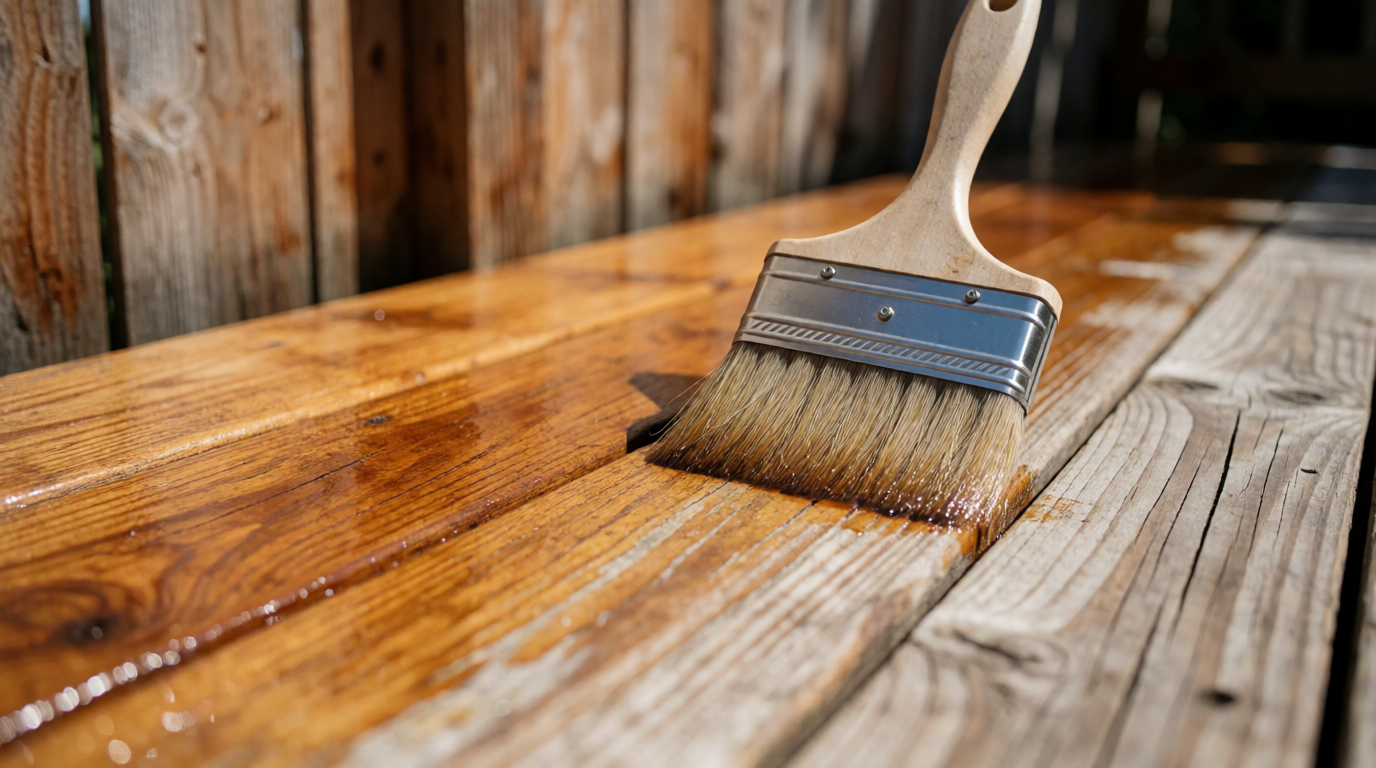
We apply the stain using a "back-brushing" technique. This means we apply the stain and then immediately work it into the wood with a brush to ensure it doesn't just sit on the surface. This is the difference between a finish that lasts one year and one that lasts four.
Step 5: Final Inspection and Curing
We perform a detailed walkthrough to ensure uniform color and no "lap marks." We then provide a curing schedule to ensure the stain fully hardens before the homeowner introduces furniture or foot traffic.
📚
Definition
Back-brushing is the process of manually pushing a sprayed or rolled stain into the wood pores using a brush to ensure maximum penetration and adhesion.
Common Objections to Professional Staining and the Data-Backed Truth
Many homeowners hesitate to hire a professional due to perceived costs or the belief that DIY kits are "good enough." However, the data suggests otherwise.
Objection 1: "I can just do this myself with a store-bought stain."
Most homeowners assume that the product is the most important part of the process. In reality, the preparation is 80% of the job. According to the Environmental Protection Agency (EPA), improper surface preparation is the leading cause of coating failure. DIY kits often lack the professional-grade cleaners and brighteners needed to actually open the wood grain, meaning the stain simply sits on top of the dead wood cells and peels off within a year. In practice, this means you spend more money and time re-doing the job every 12 months than you would by hiring a pro once every four years.
Objection 2: "Staining is too expensive compared to painting the deck."
There is a common misconception that painting is a more durable option. In truth, painting a deck is a mistake. Paint creates a plastic-like film over the wood. Because wood expands and contracts with Oakland's humidity, that film inevitably cracks. Once water gets under the paint, it becomes trapped, leading to rapid rot from the inside out. Staining, specifically penetrating oil, allows moisture to escape and prevents the "peel-and-scrape" cycle associated with painted decks. Using house painting in Mission San Jose Fremont, CA for walls is great, but for horizontal wood surfaces, stain is the only scientifically sound choice.
Objection 3: "I'll just wait until the wood looks really bad before I stain it."
This is the most expensive mistake a homeowner can make. When wood turns silver-gray, it's a sign that the lignin has been destroyed by UV rays. Once the wood is severely weathered, you are no longer paying for a "stain job"; you are paying for a "restoration job." Restoration requires significantly more labor, chemical stripping, and sanding. By maintaining a staining schedule every 2-3 years, you preserve the structural integrity of the wood and keep the maintenance costs low. Those who ignore this often find themselves needing a full replacement, which can cost 5x to 10x more than regular maintenance.
Frequently Asked Questions
How often should I stain my deck or fence in Oakland, CA?
In the California Bay Area, most wooden structures require a fresh coat of stain every 2 to 4 years, depending on the exposure to sunlight and moisture. For decks in the Oakland hills with high UV exposure, a 2-year cycle is recommended to prevent graying. For fences in shaded or foggy areas, 3 to 4 years may be sufficient. A simple "water test" can determine if it's time: drop a few beads of water on the wood; if the water sinks in quickly rather than beading up, your protective seal has failed and it is time to re-stain.
What is the difference between transparent, semi-transparent, and solid stains?
Transparent stains offer the most natural look but provide the least UV protection. Semi-transparent stains are the industry standard for Oakland homes, as they add pigment to block UV rays while still showing the wood grain. Solid stains act more like paint, offering the maximum UV protection and the ability to change the wood's color completely, but they are more prone to peeling over time. At World Pro Painting, we typically recommend semi-transparent oils for redwood and cedar to balance aesthetic beauty with long-term durability.
Can you stain a deck that is currently peeling?
Yes, but you cannot simply stain over the peeling areas. Attempting to "patch" a peeling deck results in an uneven, blotchy finish and does not solve the underlying adhesion problem. We must first remove all failing material through a process of chemical stripping and mechanical sanding. Once the original, healthy wood is exposed, we can then apply a fresh, uniform coat of stain. This restoration process is essential to ensure the new product bonds correctly and doesn't peel again within months.
Is it better to stain or seal a fence?
While the terms are often used interchangeably, there is a technical difference. A sealer is typically a clear product that protects against moisture but offers no UV protection, meaning the wood will still turn gray. A stain includes pigments that block UV rays, preserving the color of the wood while also sealing it against water. For the volatile climate of the Bay Area, staining is almost always the superior choice because it provides a dual-layer of protection: moisture repulsion and sun shielding.
How do I know if my wood contains lead paint before staining?
In older Oakland neighborhoods, it is common to find lead-based paint on fences or older decks. Before we begin any sanding or scraping, we recommend a lead test. According to the EPA's RRP Rule, specialized containment and cleanup procedures must be followed if lead is present to prevent contamination. As a licensed contractor, World Pro Painting ensures that all preparation is done safely and in compliance with California environmental regulations to protect your family and the environment.
Final Thoughts on Deck and Fence Staining in Oakland, CA
Maintaining the exterior wood of your home in the East Bay is a battle against the elements. Whether you are dealing with the salt air of the coast or the intense sun of the hills, the only way to ensure your deck and fence last for decades is through a professional, science-based approach to staining. Avoiding the common pitfalls of DIY kits and film-forming paints can save you thousands of dollars in replacement costs and countless hours of frustration.
At World Pro Painting, we bring a level of precision and expertise to deck and fence staining oakland, ca that transforms your outdoor space into a durable, high-value asset. From our rigorous 5-step preparation process to our 6-year guarantee, we ensure your wood is protected, preserved, and beautiful.
Don't wait for the wood to rot or the color to fade. Secure your home's value and beauty today. For those in the surrounding areas, we also provide expert House Painters in Brookvale Fremont, CA and other specialized services across 42 cities.
Ready to protect your outdoor investment? Schedule your Free On-Site Estimate today at World Pro Painting.
Recommended Readings
To deepen your understanding of these topics, we recommend reading the following articles:
- Fence & Deck Staining Services
- Deck and Fence Staining in Alameda, CA | Licensed Contractors
- Deck and Fence Staining in Newark, CA | Licensed Contractors
- Deck and Fence Staining in Berkeley, CA | Licensed Contractors
Commercial Painting Cost Calculator & Color Guide
Get an instant estimation checklist for painting your office, warehouse, or house. Learn how to choose colors that boost productivity.