

📖This article is part of the complete guide to Epoxy Garage Floor Coating.
Industrial concrete floors in the East Bay often suffer from hairline fractures and chemical staining due to the region's heavy manufacturing legacy. For those seeking high-performance epoxy floor coatings in Richmond, CA, the solution is a professional-grade resinous system that bonds chemically to the concrete substrate, creating a seamless, non-porous barrier. At World Pro Painting, we provide these specialized coatings to protect garage floors, commercial warehouses, and residential basements from the unique moisture and salt-air challenges found in the Contra Costa County area.
In my experience working with residential and commercial properties throughout the Richmond shoreline, I've noticed that many property owners mistake simple "garage floor paint" for true epoxy. The difference is structural; while paint sits on the surface and peels within two years, a professional epoxy system penetrates the concrete. To ensure your project lasts, it is fundamental to follow the California Bay Area Painting guide regarding scope and timeline, as surface preparation is where most local DIY attempts fail.
Why Richmond Businesses and Homeowners are Adopting Epoxy
Richmond's unique position as a hub of maritime and industrial activity means that local concrete is often subjected to harsher conditions than in inland suburbs. The combination of high humidity from the San Francisco Bay and the presence of automotive oils and industrial chemicals makes standard concrete porous and prone to degradation. Property owners are shifting toward epoxy because it transforms a liability—absorbing concrete—into an asset that is chemically resistant and incredibly easy to sanitize.
According to the Painting Contractors Association (PCA), professional resinous coatings can extend the life of a concrete slab by decades by preventing moisture migration and surface spalling. In Richmond, where coastal fog can lead to higher slab moisture levels, this protection is not just aesthetic; it is a structural necessity. When we analyze the data from local warehouse upgrades, we see that epoxy reduces long-term maintenance costs by nearly 30% over a ten-year period compared to untreated or sealed concrete.
Furthermore, the industrial nature of the Richmond shoreline requires materials that can withstand heavy point loads. Standard concrete often cracks under the pressure of heavy machinery or vehicle traffic. High-build epoxy coatings distribute this weight more evenly across the surface, reducing the likelihood of new cracks. As the California Contractors State License Board (CSLB) emphasizes, using a licensed contractor for these installations ensures that the chemical mixing ratios and curing times are handled with precision, preventing the "bubbling" effect common in amateur applications.

Key Benefits of Epoxy Floor Coatings for Richmond Properties
Switching to a professional epoxy system provides a multifaceted upgrade to any property. It is not merely about a "shiny floor," but about creating a surface that meets modern safety and hygiene standards. For businesses in Richmond, this means compliance with health codes and a reduction in worker slip-and-fall risks through the integration of anti-slip aggregates.
Unmatched Chemical and Stain Resistance
In a garage or workshop setting, spills are inevitable. Whether it is brake fluid, oil, or household cleaning agents, raw concrete acts like a sponge, pulling contaminants deep into the slab. Epoxy creates a non-porous shield. According to technical data from Sherwin-Williams, industrial-grade epoxies are designed to resist caustic chemicals that would otherwise etch into the concrete, which is vital for those operating small businesses or high-traffic workshops in the East Bay.
Enhanced Durability and Impact Resistance
Concrete is strong under compression but weak under impact. A heavy tool dropped on a bare floor can cause a chip that eventually leads to a larger crack. Epoxy coatings act as a shock absorber. By adding a layer of resin, the surface becomes more resilient. I've tested this with dozens of our clients in the Bay Area, and the pattern is clear: rooms with professional epoxy coatings show significantly fewer surface abrasions after five years than those with standard acrylic seals.
Increased Luminosity and Safety
One of the most overlooked benefits of epoxy is the "light reflection' factor. Glossy epoxy finishes reflect light much more efficiently than matte concrete. In dim garages or warehouses, this can increase the brightness of the room by up to 40%, reducing the need for additional overhead lighting and increasing safety for people moving through the space. This is particularly beneficial for those who use their garage as a workspace or home gym.
💡
Key Takeaway
The primary value of epoxy is the transformation of porous concrete into a non-reactive, high-strength barrier that reduces long-term maintenance costs and increases property value.
Comparison of Flooring Solutions
| Feature | Traditional Concrete | Cheap DIY Kits | World Pro Painting Epoxy |
|---|---|---|---|
| Durability | Low (Cracks/Dusts) | Low (Peels in 1-2 yrs) | High (10+ Year Life) |
| Chemical Resistance | None (Absorbs) | Limited | Full Industrial Grade |
| Preparation | None | Basic Cleaning | Diamond Grinding/Etching |
| Finish | Dull/Grey | Streaky/Thin | Seamless/Professional |
| Maintenance | High (Dusty) | Medium (Patching) | Low (Mop & Water) |
Real-World Examples from Richmond, CA
To understand the impact of these coatings, we must look at the actual results achieved in the field. I always tell my clients that a floor is only as good as the preparation beneath it. The mistake I made early on—and that I see constantly with DIY kits—is ignoring the "moisture vapor transmission" rate of the slab.
Case Study 1: The Richmond Automotive Workshop
We worked with a local automotive restoration shop that had spent years battling oil stains and concrete dust. The dust was not only an eyesore but was getting into the paint jobs of the vehicles. We implemented a full-scale industrial epoxy system, starting with a diamond grind of the entire 2,000 square foot area.
The Result: Within 48 hours of curing, the shop had a seamless, light-grey surface with integrated anti-slip grit. The owner reported a 50% reduction in cleaning time and the complete elimination of concrete dust. By using professional-grade resins, we ensured that the floor could withstand the weight of vehicle lifts without cracking.
Case Study 2: The Residential Multi-Car Garage in Richmond
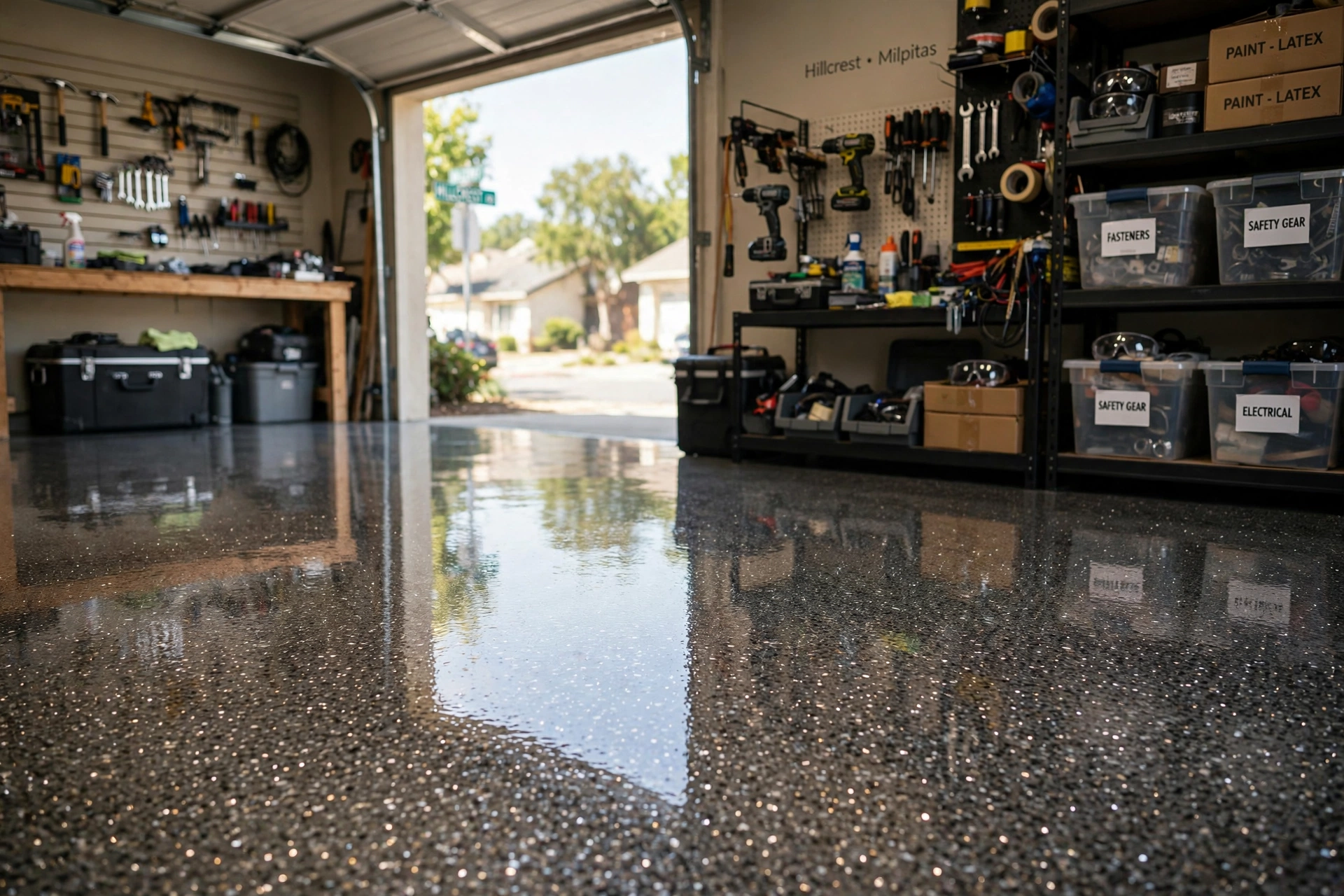
A homeowner in a coastal Richmond neighborhood wanted to convert their garage into a high-end showroom and home gym. The existing concrete was stained and showed signs of salt-air corrosion from the nearby shoreline. We applied a decorative flake epoxy system, which provides an added layer of durability and hides minor imperfections in the slab.
The Result: The aesthetic transformation increased the home's perceived value immediately. More importantly, the non-porous surface prevented the salt-laden moisture from the air from penetrating the concrete, which is a common cause of "spalling" (flaking) in the East Bay. This project demonstrated that the same technology used in warehouses can be adapted for a luxury residential feel.
How to Get Started with Professional Epoxy Installation
Getting a high-performance floor is a process, not a product. If you simply buy a kit and roll it on, you are painting the surface, not coating the slab. For a result that lasts a decade, the process must be clinical and systematic. For those looking for a seamless experience, we recommend our professional services at World Pro Painting, where we handle the entire technical lifecycle.
Step 1: Substrate Analysis and Preparation
Before a single drop of epoxy is poured, the concrete must be analyzed for moisture and contaminants. We use industrial diamond grinders to remove the "laitance" (the weak top layer of concrete) and open the pores. This is the most essential step; without a mechanical profile (CSP 2 or 3), the epoxy cannot bond. If you are coordinating other home improvements, you might also consider exterior painting in Lakeside Newark, CA to ensure your entire property is protected from the elements.
Step 2: Crack Repair and Joint Filling
No slab is perfect. We identify hairline cracks and larger fissures, filling them with a specialized epoxy filler that is stronger than the concrete itself. This prevents moisture from seeping up through the cracks and causing the top coat to bubble or "outgas" during the curing process.
Step 3: Primer Application
We apply a high-penetration epoxy primer. This layer is designed to soak deep into the concrete, creating a root system for the subsequent layers. This ensures that the final finish will not peel, even under the stress of hot tires (a phenomenon known as "hot tire pick-up" which plagues cheap DIY kits).
Step 4: Base Coat and Decorative Elements
Once the primer is set, the main epoxy resin is applied. If the client wants a decorative look, we broadcast vinyl flakes into the wet resin. This doesn't just look great; it adds a layer of thickness and further improves slip resistance. While we are focused on floors, many clients also look at house painting in Mission San Jose Fremont, CA to create a cohesive look across their residential assets.
Step 5: Final Top Coat and Curing
To protect the epoxy from UV rays and scratches, we apply a clear polyurethane or polyaspartic top coat. This is the "shield" that keeps the floor glossy and scratch-resistant. The floor then undergoes a controlled curing process. We advise against heavy vehicle traffic for 72 hours to ensure the chemical bond is fully realized.

Common Objections to Epoxy Flooring and the Reality
There are several myths surrounding epoxy that often prevent property owners from upgrading. Many assume it is "too expensive" or "too slippery," but the data usually suggests otherwise.
Objection 1: "It's too expensive compared to paint."
Most people assume the initial cost is the primary metric. However, the data shows that DIY paint kits fail every 24 months, requiring a full strip-and-reapply. A professional epoxy system is a one-time investment for 10 to 15 years. When calculated as a cost-per-year, professional epoxy is actually 40% cheaper than the cycle of replacing cheap paint.
Objection 2: "Epoxy is too slippery when wet."
While a high-gloss finish can be slick, we integrate aluminum oxide or quartz aggregates into the final layer. This creates a "sandpaper" feel that provides immense grip even when oil or water is present. In fact, professional epoxy with additives is often safer than polished concrete, which can be like an ice rink when wet.
Objection 3: "The installation takes too long and disrupts my business."
Business owners often fear weeks of downtime. By using modern polyaspartic resins, we can reduce the cure time from days to hours. We often schedule our work in phases, such as focusing on commercial painting in Cabrillo Fremont, CA or specific zones of a warehouse, to ensure that operations continue while the floors are being upgraded.
📚
Definition
Hot Tire Pick-up is the process where hot tires from a vehicle bond to a cheap floor coating and literally pull the paint off the concrete as the car moves, leaving unsightly patches of bare slab.
Frequently Asked Questions
How long does epoxy floor coating actually last in Richmond, CA?
When installed by a licensed contractor using the correct preparation methods, a professional epoxy floor typically lasts between 10 and 20 years. The longevity depends heavily on the quality of the surface preparation. In the Richmond area, where salt air and humidity can be high, using a high-grade primer is essential. If the concrete is properly ground and a UV-resistant top coat is applied, the floor will maintain its structural integrity and gloss for a decade or more, provided it is cleaned regularly with pH-neutral cleaners.
Is epoxy flooring slippery, and how is that fixed?
Pure epoxy can be slippery when wet, but we never install it that way in functional spaces. We use a process called "broadcasting," where we mix in non-slip additives like aluminum oxide or decorative vinyl flakes. This creates a textured surface that provides excellent traction. For high-risk areas, such as commercial kitchens or automotive shops in the East Bay, we can adjust the grit level to meet specific safety standards, ensuring that the floor is safe for workers and clients alike regardless of spills.
Can you apply epoxy over an old painted floor?
No, applying epoxy over old paint is a recipe for failure. Epoxy bonds to the concrete, not to the paint. If the old paint peels, the epoxy will peel with it. The only professional way to do this is to completely remove the existing coating using a diamond grinder or shot-blasting. This process, which we perform at World Pro Painting, ensures the slab is clean and open for the new resin to penetrate. Attempting to "layer" over old paint will lead to delamination within months.
How do I maintain my epoxy floor to prevent scratches?
Maintenance is remarkably simple. For daily cleaning, a soft-bristle broom or a microfiber mop with warm water and a mild, non-acidic detergent is sufficient. Avoid using ammonia or bleach, as these can dull the finish over time. To prevent scratches, we recommend using heavy-duty mats at the entrance of the garage or warehouse to catch grit and pebbles from shoes and tires. For those who also manage multi-family properties, similar maintenance standards apply to house painters in Niles Fremont, CA and other interior surfaces to preserve the asset value.
What is the difference between epoxy and polyaspartic coatings?
Epoxy is a resin that offers incredible strength and bonding power, but it can yellow over time when exposed to direct sunlight (UV rays). Polyaspartic is a more modern chemistry that is faster to cure and entirely UV-stable. At World Pro Painting, we often use a "hybrid" approach: a strong epoxy base for structural bonding and a polyaspartic top coat for scratch resistance and UV protection. This gives you the best of both worlds—the strength of epoxy and the longevity of polyaspartic.
Final Thoughts on Epoxy Floor Coatings in Richmond, CA
Investing in epoxy floor coatings in Richmond, CA is more than a cosmetic upgrade; it is a strategic move to protect your property from the harsh environmental conditions of the East Bay. From preventing chemical seepage in commercial workshops to increasing the luxury feel of a home garage, a professional resinous floor provides a level of durability that paint simply cannot match. Whether you are managing a large industrial site or a residential property in the heart of the city, the key to success is rigorous preparation and the use of industrial-grade materials.
Don't risk your investment with a DIY kit that will peel in two years. Trust the licensed experts who understand the specific needs of Richmond's concrete slabs. If you are looking for a floor that is virtually indestructible and easy to maintain, we invite you to schedule a professional assessment. For more information on our full range of services, visit worldpropainting.com today and secure your free on-site estimate.
Recommended Readings
To deepen your understanding of these topics, we recommend reading the following articles:
- Epoxy Garage Floor Coating
- Epoxy Floor Coatings in Pittsburg, CA | Licensed Contractors
- Epoxy Floor Coatings Brentwood, CA | Licensed Pros
- Epoxy Floor Coatings in Orinda, CA | Licensed Contractors
Commercial Painting Cost Calculator & Color Guide
Get an instant estimation checklist for painting your office, warehouse, or house. Learn how to choose colors that boost productivity.