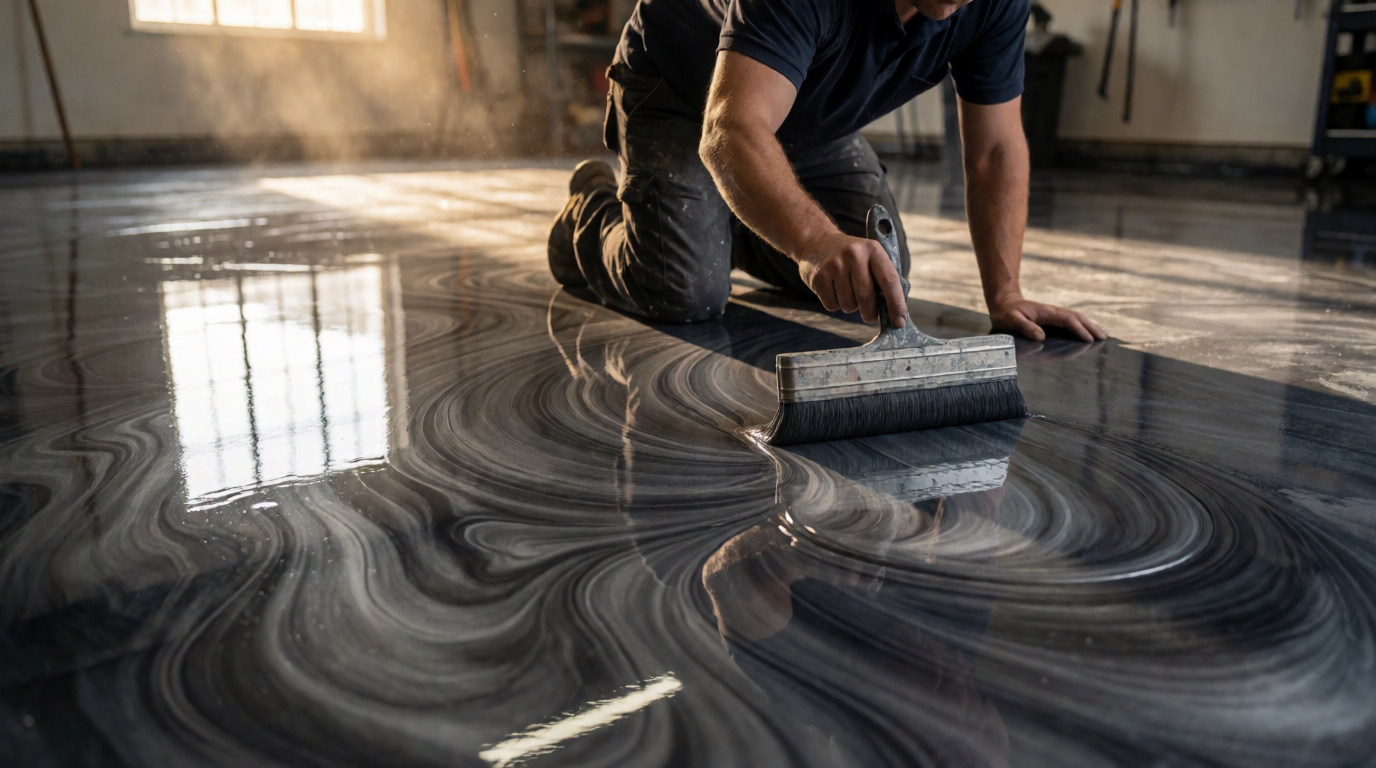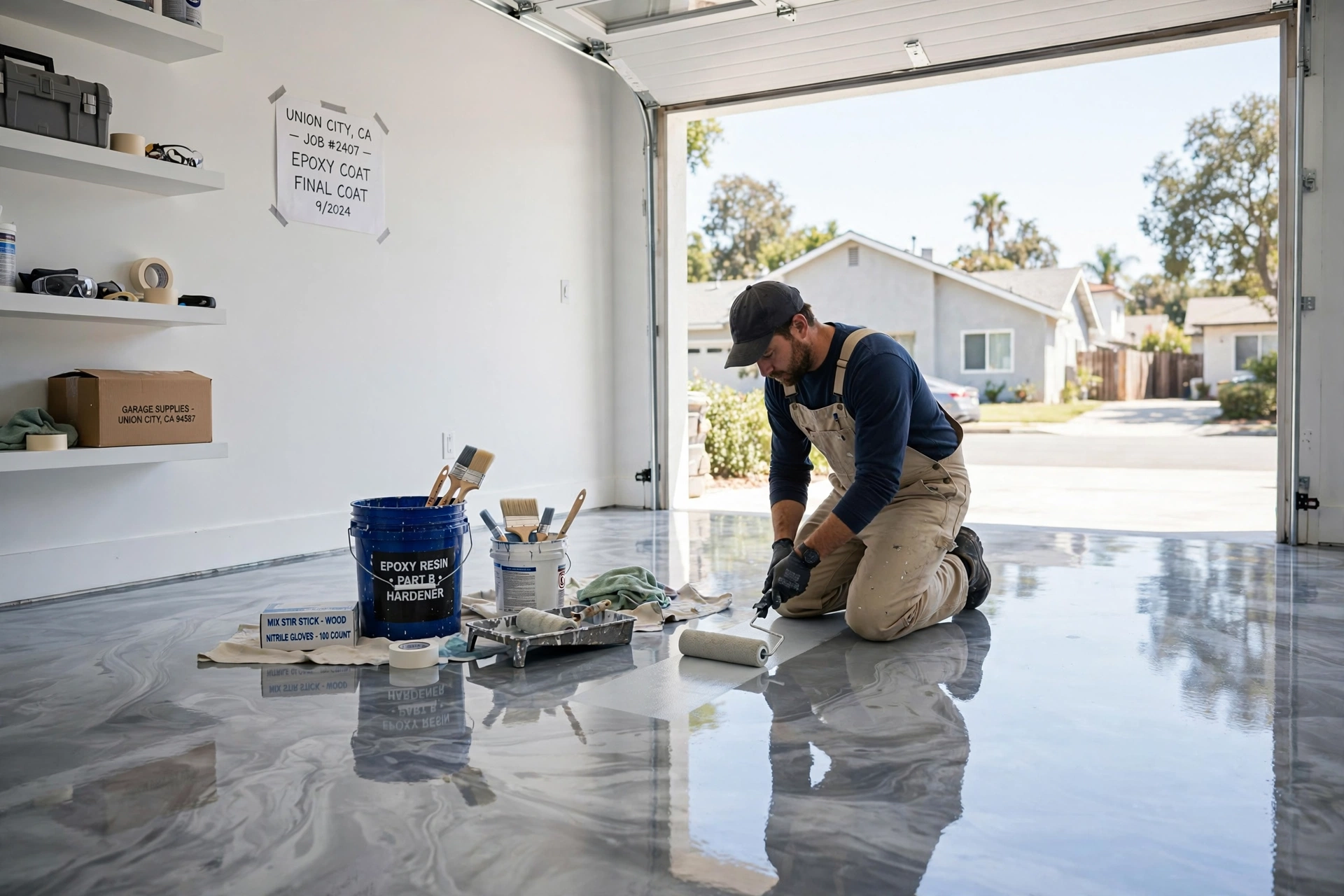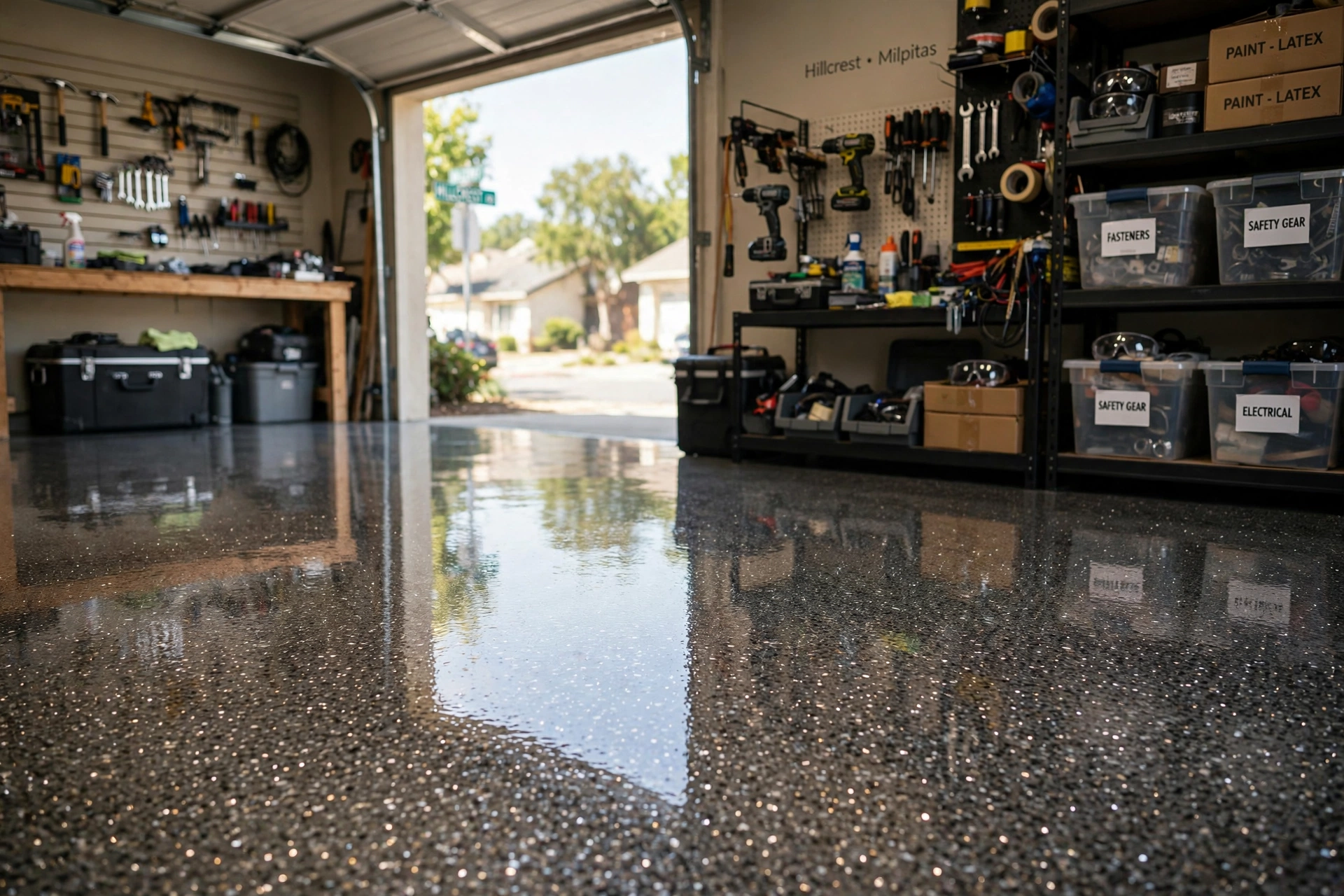


📖This article is part of the complete guide to Epoxy Garage Floor Coating.
Concrete floors in residential garages and commercial spaces often suffer from hairline cracks, oil absorption, and dusting that degrade property value. For those seeking epoxy floor coatings in San Lorenzo, CA, the solution is a high-solids resinous system that bonds chemically to the concrete substrate, creating a seamless, non-porous surface that resists chemicals and heavy impact. At World Pro Painting, we provide these professional-grade installations to ensure your floors withstand the specific humidity and usage patterns of the East Bay area.
In my experience working with homeowners and business owners in San Lorenzo, the most common mistake is attempting a DIY kit from a big-box store. These water-based products lack the chemical bond required for longevity, often peeling within 24 months. Professional epoxy involves diamond grinding the concrete to open the pores, ensuring the resin penetrates deep into the slab for a permanent finish. For those planning a larger renovation, reviewing our Bay Area project guide can help align your flooring goals with overall property improvement.
Why San Lorenzo Property Owners are Adopting Epoxy Floors?
Property owners in San Lorenzo are shifting toward epoxy because traditional concrete is fundamentally porous and prone to failure under the stress of California's fluctuating moisture levels. Whether it is a home garage near the foothills or a commercial warehouse, untreated concrete absorbs oils and salts, leading to internal structural degradation over time. The adoption of high-performance coatings is not just an aesthetic choice but a strategic asset protection move.
According to the Painting Contractors Association (PCA), professional resinous coatings can extend the lifespan of a concrete slab by preventing moisture intrusion and carbonation. In the San Lorenzo area, where seasonal rain can lead to hydrostatic pressure under slabs, a sealed floor acts as a critical barrier. This is particularly important for those who use their garages as workshops or secondary living spaces, where dust mitigation is a primary health concern.
Furthermore, the shift is driven by the need for easier maintenance. In an environment where we see a mix of residential suburban layouts and light industrial zones, the ability to sanitize a floor with a simple mop—rather than scrubbing porous concrete—saves hours of labor per month. The data shows that industrial-grade epoxy increases the reflective light quality of a room by up to 30%, reducing the need for additional overhead lighting and lowering energy costs for local businesses.

What are the Key Benefits of Epoxy for Local Spaces?
Implementing a professional epoxy system provides a level of resilience that standard paint or sealers cannot match. The primary advantage is the chemical bond; unlike acrylics that sit on top of the surface, epoxy penetrates the concrete, creating a monolithic layer that is virtually impossible to chip or peel when installed correctly.
Unmatched Durability and Impact Resistance
In a high-traffic San Lorenzo garage or storefront, the floor is subjected to constant abrasion from tires, foot traffic, and dropped tools. Industrial epoxy is engineered to withstand these stresses. While standard concrete can crack under point-load pressure, a thick-build epoxy coating distributes the weight more evenly and protects the underlying slab from impact fractures. This durability is essential for those who prioritize a "one-and-done" solution over frequent repairs.
Chemical and Stain Resistance
For homeowners and commercial entities, the ability to resist stains is a game-changer. According to Sherwin-Williams, high-performance epoxy coatings are designed to resist acids, bases, and organic solvents that would otherwise eat into raw concrete. Whether it is a leaked gallon of motor oil in a driveway or a spilled cleaning agent in a laundry room, the non-porous nature of epoxy ensures these substances stay on the surface for easy cleanup.
Enhanced Safety and Visibility
Safety is often overlooked until an accident occurs. Epoxy floors can be customized with anti-slip additives—such as aluminum oxide or quartz—that provide traction even when the floor is wet. Additionally, the high-gloss finish of a professional epoxy job increases light reflectivity. This is a critical safety feature for San Lorenzo residents who spend time in dimmer garage environments, as it significantly improves visibility around vehicles and equipment.
💡
Key Takeaway
Professional epoxy coatings don't just cover the floor; they chemically transform the concrete into a waterproof, impact-resistant shield that increases property value and reduces long-term maintenance costs.
Comparison of Flooring Approaches
| Feature | DIY Hardware Store Kits | Basic Concrete Sealer | Professional Epoxy System |
|---|---|---|---|
| Bond Strength | Surface-level (prone to peeling) | Weak (temporary) | Chemical Bond (Permanent) |
| Durability | 1-3 Years | 1-2 Years | 10-20+ Years |
| Chemical Resistance | Low | Moderate | Extremely High |
| Preparation | Acid wash (often skipped) | Minimal | Diamond Grinding/Shot Blasting |
| Finish Quality | Streaky / Bubbles | Dull / Basic | Mirror-like / Industrial |
Real-World Examples of Epoxy Installations in San Lorenzo
To understand the impact of a professional installation, it is helpful to look at the actual results achieved in the field. I have seen countless projects where the difference between a "coat of paint" and a "resinous system" becomes clear after the first winter season.
Case Study 1: The Residential Multi-Car Garage
A homeowner in San Lorenzo approached us with a garage floor that was severely stained from a ten-year accumulation of oil drips and salt. The concrete was dusting, leaving a fine white powder on every surface in the house. We utilized a three-stage process: industrial diamond grinding to remove the contaminated surface layer, a moisture-vapor barrier primer, and a high-build epoxy flake system. The result was a 100% reduction in concrete dusting and a surface that looked brand new. The property value increased significantly, as the garage now felt like an extension of the home's interior rather than a utility shed.
Case Study 2: Small Commercial Workshop
A local automotive repair shop needed a floor that could handle heavy machinery and frequent chemical spills. They had previously used a cheap sealant that had peeled in 40% of the high-traffic zones. We implemented a 100% solids epoxy coating with an integrated cove base (where the floor curves up the wall), which prevents liquids from seeping into the walls. After six months of heavy use, the floor showed zero signs of delamination. The shop owner reported that cleaning time was reduced by 50% because the seamless surface allowed for rapid sweeping and mopping without the debris getting trapped in cracks.
How to Get Started with Epoxy Floor Coatings in San Lorenzo, CA
Getting a professional epoxy floor is not as simple as pouring paint. It is a precision engineering process. If you are considering this upgrade, you should follow a structured approach to ensure the longevity of the investment. If you're also looking at exterior improvements, our exterior painting in Lakeside Newark services can complement your overall home renovation strategy.
📚
Definition
Diamond Grinding is the process of using industrial diamonds embedded in rotating discs to mechanically remove the top layer of concrete, creating a precise profile (CSP) that allows epoxy to grip the surface.
Step 1: Surface Assessment and Moisture Testing
Before a single drop of resin is poured, the concrete must be tested for moisture. If the slab is breathing moisture from the soil, standard epoxy will bubble and peel. We use calcium chloride tests or moisture meters to determine if a specialized moisture-vapor barrier is required. This is the most skipped step in DIY projects and the primary reason they fail.
Step 2: Mechanical Preparation
As mentioned, we don't rely on acid etching. We use heavy-duty grinders to remove all contaminants, oils, and old sealers. This process opens the "pores" of the concrete. Without this, the epoxy is simply sitting on top of dirt and will eventually lift off the floor.
Step 3: Priming and Base Coat Application
Once the floor is vacuumed and pristine, a high-performance primer is applied. This acts as the glue between the concrete and the main coating. We then apply the base coat of epoxy, which provides the structural thickness and color.
Step 4: Broadcast and Topcoat
For a decorative and durable finish, we broadcast vinyl flakes or quartz into the wet base coat. This adds texture and hides imperfections in the concrete. Finally, we apply a UV-stable topcoat. Most epoxies yellow under sunlight; a high-quality polyaspartic or urethane topcoat prevents this and adds a final layer of scratch resistance.
Step 5: Curing and Inspection
We allow the floor to cure in a controlled environment. While you can walk on the floor in 24 hours, full chemical cure typically takes 7 days. We conduct a final walkthrough to ensure there are no voids or uncoated areas.
For those who need specialized attention in nearby areas, we also offer house painting in Niles Fremont, applying the same rigorous preparation standards to every surface we touch.

Common Objections and Professional Answers
When I consult with clients in San Lorenzo, I often encounter a few recurring doubts. Most of these stem from experiences with poor-quality installations or outdated products. Here is the reality backed by industry data.
Objection 1: "Isn't epoxy too expensive compared to paint?"
Most people assume the higher upfront cost is a drawback, but the data shows the opposite. A DIY paint job lasts 2 years, meaning you pay for materials and labor five times over a decade. A professional epoxy system lasts 15-20 years. When you calculate the cost per year of service, epoxy is significantly cheaper. Furthermore, it adds tangible equity to the home, which a simple coat of paint does not.
Objection 2: "I've heard epoxy floors are slippery when wet."
This is a common misconception. While a smooth, high-gloss floor can be slippery, we integrate slip-resistant additives during the topcoat process. By adding a specific percentage of aluminum oxide, we create a surface that is safer than polished concrete or tile. This is a standard requirement for commercial spaces to meet safety regulations and avoid liability.
Objection 3: "Will the epoxy crack if my concrete cracks?"
Here is the thing: epoxy is rigid. If your house has a major structural shift and the slab cracks, the epoxy will likely crack with it. However, the coating prevents water and chemicals from entering that crack, which stops the crack from widening. We use high-quality fillers to bridge existing hairline cracks before coating, ensuring a seamless look that protects the slab's integrity.
Objection 4: "Does it smell too strong during installation?"
Older epoxies had high VOC (Volatile Organic Compounds) that created a powerful odor. Today, we use low-VOC and 100% solids resins that have minimal scent. According to the Environmental Protection Agency (EPA), using certified low-emission materials is essential for indoor air quality, and that is exactly what we prioritize at World Pro Painting.
Frequently Asked Questions
How long does it take to install epoxy floor coatings in San Lorenzo, CA?
A professional installation typically takes 3 to 5 days. This timeline is necessary because the preparation—specifically diamond grinding—cannot be rushed. Day one is dedicated to grinding and cleaning. Day two involves the primer and base coat. Day three is for the flake broadcast and topcoat. We then allow a curing period before the client can bring vehicles back into the space. Rushing this process leads to "outgassing," where air bubbles get trapped in the resin, ruining the finish.
Can epoxy be applied over existing paint or sealer?
No, epoxy cannot be applied directly over existing paint, wax, or sealers. Epoxy requires a mechanical bond with the concrete itself. If we apply it over paint, the epoxy will bond to the paint, but the paint will eventually peel off the concrete, taking the expensive epoxy with it. This is why we use heavy machinery to strip the floor back to raw, virgin concrete. This ensures the bond is permanent and the floor will not delaminate over time.
What is the difference between epoxy and polyaspartic coatings?
Epoxy is a resin used primarily as a base layer for its incredible strength and adhesive properties. Polyaspartic is a faster-curing, more UV-stable coating. While epoxy can yellow if exposed to direct sunlight (common in open San Lorenzo carports), polyaspartic remains clear and hard. At World Pro Painting, we often use a "hybrid" approach: an epoxy base for strength and a polyaspartic topcoat for UV protection and rapid cure times, giving the client the best of both worlds.
How do I maintain my epoxy floor to make it last 20 years?
Maintenance is remarkably simple. For daily cleaning, use a soft broom or a microfiber dust mop. For deeper cleans, a mixture of warm water and a pH-neutral cleaner is sufficient. You should avoid using harsh acids or ammonia-based cleaners, as these can dull the gloss over time. I always recommend placing heavy rubber mats under heavy machinery or toolboxes to prevent point-load scratching, ensuring the mirror finish remains intact for decades.
Does the concrete need to be perfectly level before coating?
Epoxy is a thin-film coating, meaning it follows the contours of the floor. It will not hide a major slope or a deep dip in the concrete. However, we can use an epoxy filler or a self-leveling underlayment to patch holes, cracks, and uneven seams. This creates a smooth, professional surface before the final color is applied. If your floor has significant drainage issues, we can consult on how to address those before the coating process begins.
Final Thoughts on Epoxy Floor Coatings in San Lorenzo, CA
Investing in epoxy floor coatings in San Lorenzo, CA is one of the most effective ways to protect your property from the elements and daily wear. By moving away from porous, dusty concrete and adopting a chemically bonded resinous system, you eliminate the cycle of constant patching and cleaning. Whether you are enhancing a residential garage or upgrading a commercial facility, the combination of diamond grinding and high-solids epoxy provides a finish that is both aesthetically stunning and industrially durable.
Don't risk your investment with low-grade kits that peel within a few years. Trust a licensed contractor who understands the specific needs of the California Bay Area climate and concrete conditions. For an unmatched finish and a 6-year guarantee, contact the experts at World Pro Painting. Whether you need a simple garage refresh or a complex industrial overhaul, we provide the precision and materials required for a permanent result.
Schedule your free on-site estimate today at worldpropainting.com and experience the difference of a professionally engineered floor.
Recommended Readings
To deepen your understanding of these topics, we recommend reading the following articles:
- Epoxy Garage Floor Coating
- Epoxy Floor Coatings in Clayton, CA | Licensed Contractors
- Epoxy Floor Coatings in Martinez, CA | Licensed Contractors
- Epoxy Floor Coatings in San Leandro, CA | Licensed Contractors
Commercial Painting Cost Calculator & Color Guide
Get an instant estimation checklist for painting your office, warehouse, or house. Learn how to choose colors that boost productivity.