

How Do You Choose Between Different Types of Cabinet Refinishing Experts?
Walking into a kitchen with peeling paint or dated oak stains often leads homeowners to a crossroads: replace everything or refinish. The "how" of this process depends entirely on who you hire. Selecting from the various types of cabinet refinishing experts determines whether your kitchen looks like a professional showroom or a DIY project gone wrong. To get a factory-grade finish, you must match the specific technical requirements of your cabinetry—be it solid wood, MDF, or thermofoil—with a contractor who specializes in that specific chemical bond.
In my experience working with hundreds of Bay Area homes, the biggest mistake I see is homeowners hiring a general "handyman" for a task that requires a specialized spray booth. A generalist might be great at patching drywall, but they often lack the high-volume low-pressure (HVLP) equipment needed to prevent drip marks on cabinet doors. For those managing larger properties, understanding how to coordinate these services is similar to how Multi-Family Painters in Weibel - Fremont, CA handle large-scale residential updates, where consistency across multiple units is the primary goal.
What Are the Primary Types of Cabinet Refinishing Experts?
When you begin searching for the right professional, you will find that the market is split into three distinct categories: the specialized cabinet refinisher, the full-service painting contractor, and the factory-refinishing shop. Each operates with a different workflow and set of tools, which directly impacts the durability of the final product.
📚
Definition
Cabinet Refinishing is the process of updating the appearance of kitchen or bathroom cabinets through painting, staining, or laminating without replacing the actual cabinet boxes or door structures.
The specialized cabinet refinisher typically focuses exclusively on millwork. They are experts in "grain filling" and "degreasing," two steps that are often skipped by generalists. They use chemical strippers and sanding equipment specifically calibrated for hardwoods like maple or cherry. According to the Painting Contractors Association (PCA), professional preparation—including the removal of all oils and contaminants—is the single most important factor in paint adhesion, accounting for the majority of long-term failures in residential cabinetry.
Then you have the full-service painting contractor, such as World Pro Painting. These experts provide a comprehensive approach, integrating the cabinetry work into a larger home improvement plan. This is often the most efficient route for homeowners who are also updating their walls and ceilings. By utilizing How to Use California Bay Area Painting techniques, these professionals can ensure that the cabinet sheen complements the overall lighting and color palette of the room.
Finally, there are factory-refinishing shops. These experts remove your doors and drawers and transport them to an off-site facility. This allows them to use industrial-grade spray booths and curing ovens. While this provides the highest possible finish, it leaves your kitchen "skeletonized" for several days or weeks, which is a significant logistical hurdle for families.
Why Choosing the Right Expert Matters for Your Home's ROI
The decision of which expert to hire isn't just about aesthetics; it is a financial calculation. In the California Bay Area, where real estate values are among the highest in the nation, the quality of your finishes directly impacts your home's appraisal. A poorly executed cabinet job is an immediate "red flag" for buyers, suggesting a lack of attention to detail throughout the rest of the home's maintenance.
Research into home improvement trends indicates that kitchen remodels provide one of the highest returns on investment (ROI), often recovering 60% to 80% of the cost. However, this ROI is predicated on a "professional" look. According to Sherwin-Williams, using high-performance coatings like urethanes or alkyds—which require professional application—increases the lifespan of the finish by years compared to standard latex paints. If a non-expert applies these paints with a brush, the result is "brush marks" and "orange peel" texture, which drastically lowers the perceived value of the kitchen.
Furthermore, there is the risk of environmental and safety hazards. In older Bay Area homes, especially those in San Francisco or Oakland, the risk of encountering lead-based paint is high. The Environmental Protection Agency (EPA) mandates the RRP (Renovation, Repair, and Painting) rule for any firm performing renovation work in pre-1978 homes. Hiring an expert who is not EPA-certified for lead-safe work can result in hazardous dust contaminating your living space and potential legal liabilities for the homeowner.
Practical Application: How to Execute a Professional Refinishing Project
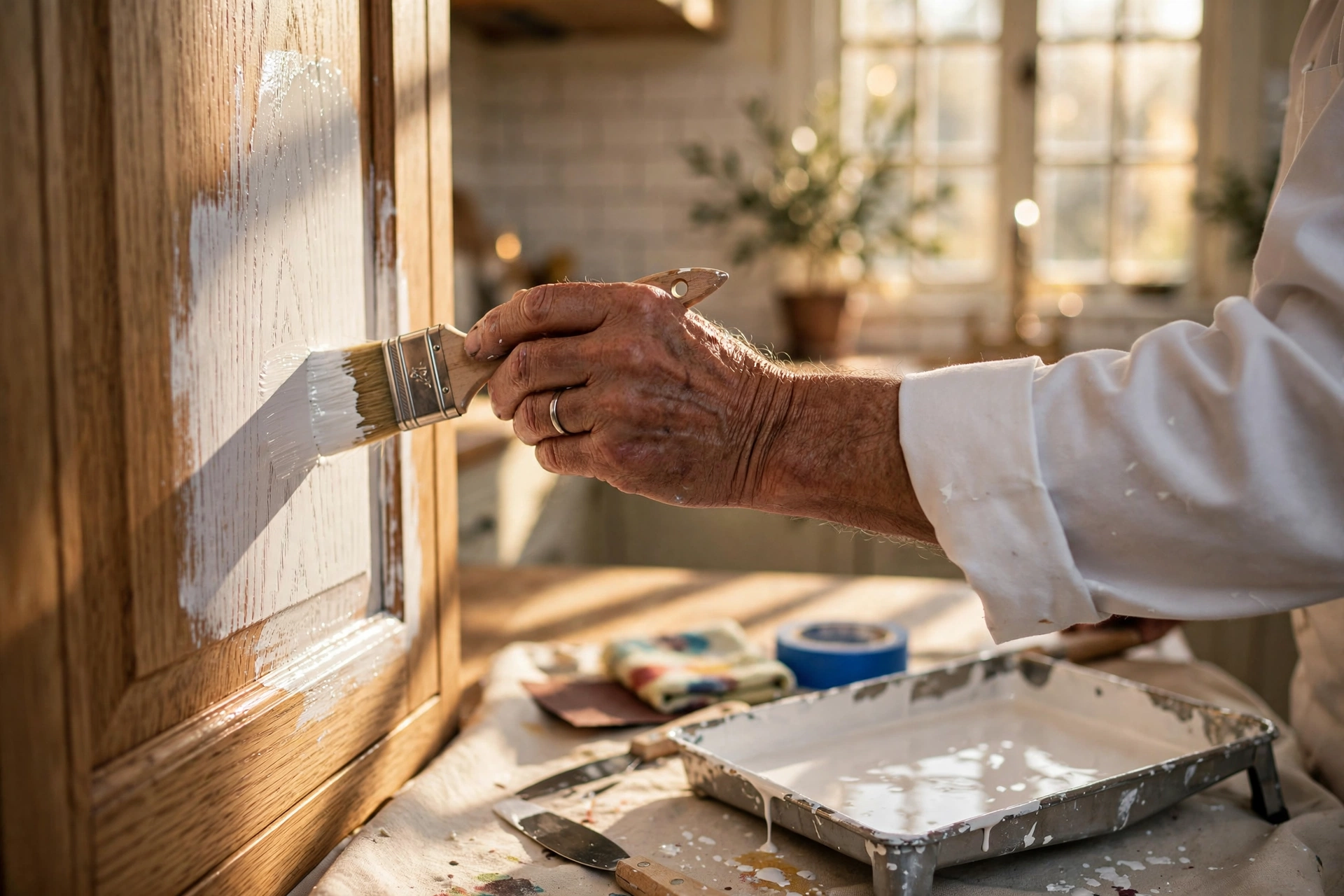
If you are wondering how to actually manage the process of refinishing, it follows a rigorous technical sequence. Whether you hire a specialized shop or a full-service contractor like World Pro Painting, the "how" should always follow these five critical phases. If a contractor tells you they can "just paint over" the existing finish, they are not a cabinet expert.
Step 1: Chemical Degreasing and De-glossing
Kitchen cabinets are covered in a microscopic layer of aerosolized grease from cooking. Standard soap doesn't remove this. Experts use TSP (Trisodium Phosphate) or specialized degreasers to strip the oils. Without this, the new paint will peel off in sheets within six months.
Step 2: Mechanical Sanding and Surface Prep
Once clean, the surface must be "toothed." This involves sanding with 120-grit to 220-grit sandpaper to create a mechanical bond for the primer. In my experience, this is where most DIYers fail; they sand too little, or they sand so much they round off the crisp edges of the cabinet profiles.
Step 3: Specialized Priming
Not all primers are equal. For cabinets, a high-adhesion, stain-blocking primer is essential. For example, if you are painting over old cherry wood, you need a primer that prevents "tannin bleed," where the red oils of the wood seep through the white paint.
Step 4: Precision Application (The Spray Phase)
The "how" of the application determines the texture. Professionals use HVLP sprayers to apply thin, even coats. This prevents the "pooling" of paint in the corners of the door panels. This level of precision is why many homeowners choose Commercial Painting in Cabrillo - Fremont, CA experts even for residential work, as they possess the industrial equipment necessary for a flat, mirror-like finish.
Step 5: Controlled Curing
Paint is "dry" in an hour, but it isn't "cured" for weeks. Experts will advise you on how to handle the cabinets during the curing phase—avoiding harsh cleaners and heavy scrubbing for at least 14 to 30 days.
💡
Key Takeaway
The durability of your cabinets is decided in the preparation phase, not the painting phase. If the contractor doesn't spend at least 60% of their time cleaning and sanding, the project will likely fail.
Comparing Your Refinishing Options
Choosing the right expert depends on your budget, your timeline, and the current state of your cabinets. Here is a data-driven comparison to help you decide.
| Expert Type | Pros | Cons | Best For |
|---|---|---|---|
| Specialized Cabinet Refinisher | Extreme detail, grain filling experts | Higher cost per door, limited scope | High-end custom cabinetry, hardwoods |
| Full-Service Contractor | One-stop shop, coordinated colors | Slower specialized turnaround | Full kitchen remodels, Bay Area homes |
| Factory-Refinishing Shop | Mirror-finish, industrial curing | Kitchen is unusable for weeks | Thermofoil or heavily damaged surfaces |
| General Handyman | Lowest initial cost | High risk of peeling, brush marks | Low-value rentals, temporary fixes |
Now, here's where it gets interesting: many people assume the "Factory-Refinishing Shop" is always the best because of the equipment. However, for many homeowners in the East Bay, the convenience of an on-site professional who can also handle Exterior Painting in Lakeside, Newark, CA or other home improvements outweighs the marginal gain in finish smoothness. The "Modern Approach" combines high-end portable spray equipment with on-site masking, giving you a factory finish without the logistical nightmare of removing your doors.
Common Questions and Misconceptions
Most guides on the internet get cabinet refinishing wrong because they treat it like painting a wall. It isn't. Walls are porous; cabinets are non-porous, high-touch surfaces.
Myth 1: "You can just use a high-quality paint and a roller."
Correction: Rollers leave a texture called "stipple." While this might be acceptable for a bedroom wall, it looks amateur on a cabinet. A professional finish requires a spray application. If you see a contractor only bringing a roller and a brush, they are not a refinishing expert.
Myth 2: "Sanding is optional if you use the right primer."
Correction: Primers provide chemical adhesion, but sanding provides mechanical adhesion. In the humid microclimates of the Bay Area, relying solely on chemical bonds is a risk. Mechanical sanding is a non-negotiable step for a 10-year finish.
Myth 3: "All 'Cabinet Paint' is the same."
Correction: There is a massive difference between acrylic latex and waterborne alkyd paints. Alkyds dry harder and are more resistant to the oils and acids found in a kitchen. Experts will almost always use a hybrid alkyd or a specialized urethane enamel.
Myth 4: "Painting is always cheaper than replacing."
Correction: While generally true, if your cabinets are made of cheap particle board (MDF) that has swollen due to water damage, refinishing is a waste of money. An expert will tell you when to stop painting and start replacing.
Frequently Asked Questions
How long does a professional cabinet refinishing project typically take?
Depending on the size of the kitchen and the type of expert hired, you should expect a timeline of 7 to 14 days. The process is slow because of the drying and curing times required between the degreasing, sanding, priming, and multiple coats of finish. For example, a high-quality primer needs several hours to bond before it can be lightly sanded and painted. If a contractor promises to finish your kitchen in 48 hours, they are likely skipping the critical preparation and curing phases, which will lead to premature peeling and chipping.
Can you paint over thermofoil cabinets, or do they need to be stripped?
Thermofoil is essentially a plastic wrap glued to MDF. Painting over it is notoriously difficult because most paints cannot bond to plastic. A true refinishing expert will use a specialized "bonding primer" or a chemical etch to create a surface that the paint can grip. In some cases, the thermofoil must be carefully stripped away if it is already peeling. This is a high-risk procedure that requires a specialist; a general painter will often fail here, resulting in paint that peels off in large sheets within weeks.
What is the difference between a stain and a paint finish for cabinets?
Staining is a transparent or semi-transparent process that allows the natural wood grain to show through. It requires a "stain-grade" wood and involves a sequence of conditioner, stain, and a clear protective topcoat (like polyurethane). Painting is an opaque process that covers the wood entirely. Painting is generally more durable and offers a wider variety of color choices, while staining is preferred for high-end hardwoods like walnut or oak where the natural beauty of the grain is the primary goal.
How do I know if my cabinets have lead-based paint before refinishing?
If your home was built before 1978, there is a significant chance the original cabinets have lead-based paint. You can purchase a DIY lead test kit from a hardware store, but for a definitive answer, you should hire an EPA-certified professional. Experts use XRF (X-ray fluorescence) analyzers or lab-tested chips to confirm lead presence. Because lead dust is a severe neurotoxin, any sanding or stripping must be done using HEPA-filtered vacuum systems and wet-sanding techniques to prevent the dust from entering your home's ventilation system.
Why are some cabinet refinishing experts so much more expensive than others?
The price difference usually reflects the equipment and the "prep-to-paint" ratio. Cheap contractors spend 20% of their time on prep and 80% on painting. Premium experts, like those at World Pro Painting, spend 70% of their time on cleaning, sanding, and priming. They use expensive HVLP sprayers, high-grade industrial coatings from brands like Benjamin Moore, and spend hours masking off your entire kitchen to ensure no overspray hits your countertops. You aren't paying for the paint; you are paying for the labor of the preparation.
Final Thoughts on Types of Cabinet Refinishing Experts
Understanding the different types of cabinet refinishing experts allows you to move from a "hope for the best" strategy to a "guaranteed result" strategy. Whether you need the industrial precision of a factory shop or the coordinated expertise of a full-service contractor, the key is to prioritize the preparation phase over the final coat. In the high-stakes environment of Bay Area real estate, the difference between a "painted kitchen" and a "refinished kitchen" can be thousands of dollars in home equity.
If you are ready to transform your space with a professional, durable finish, the team at World Pro Painting is here to help. We combine the technical precision of specialized refinishers with the convenience of a full-service contractor, ensuring your home is protected and your results are flawless. For a comprehensive look at our services, explore our Exterior Painting in Birch Grove - Newark, CA guide or contact us for a free on-site estimate.
Visit worldpropainting.com to schedule your consultation and ensure your cabinetry receives the expert attention it deserves.
Reference Sources
For deeper context on this topic, these sources provide additional authoritative perspectives:
- Wikipedia — general knowledge reference
- GitHub — development and technology documentation
- The New York Times — news and journalistic updates
These references help establish a complete view of the subject matter.
Commercial Painting Cost Calculator & Color Guide
Get an instant estimation checklist for painting your office, warehouse, or house. Learn how to choose colors that boost productivity.