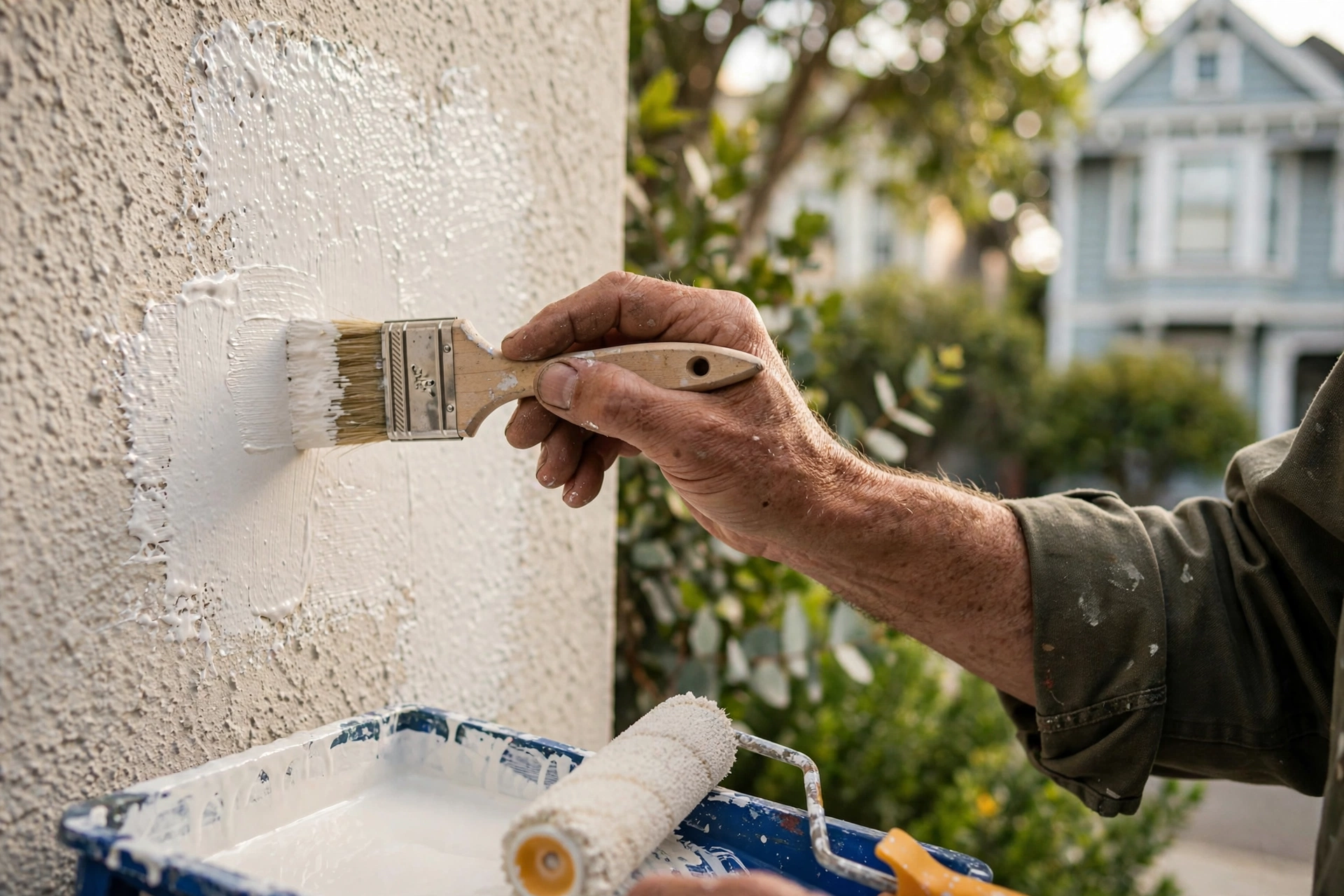


Licensed House Painting in Berkeley, CA (CSLB #1142478): World Pro Painting brings 25+ years of Bay Area experience, a rigorous 5-step surface preparation process, premium Sherwin-Williams & Benjamin Moore coatings, and a 6-year workmanship warranty. Request a Free Estimate Online or call (510) 203-5904.
Berkeley's unique architecture, from classic Craftsman bungalows to Mid-Century Moderns, often relies on stucco for its durability and timeless appeal. However, the coastal humidity and fluctuating temperatures of the East Bay take a heavy toll on these surfaces, leading to hairline cracks and fading. For homeowners seeking professional stucco painting berkeley, ca, the solution involves more than just a new coat of color; it requires a rigorous five-step preparation process—power washing, scraping, sanding, caulking, and priming—to ensure the paint bonds to the masonry and prevents moisture intrusion.
In my experience working with homeowners in the Berkeley Hills and the Gourmet Ghetto, I've noticed that many residents wait until they see visible peeling before calling a professional. By then, the moisture has often penetrated the stucco layer, risking structural damage. For those managing larger properties, understanding how to use California Bay Area painting standards is the first step toward preserving property value in 2026.

Why Berkeley Homeowners are Prioritizing Stucco Restoration in 2026
Stucco is an incredibly resilient material, but it is not invincible. In the San Francisco Bay Area, the combination of salt-heavy air from the coast and the inland heat creates a "expansion-contraction" cycle that stresses the exterior skin of a home. This is why professional stucco painting in Berkeley, CA, has shifted from a purely aesthetic choice to a critical maintenance requirement. When stucco is left unpainted or the existing coating fails, the porous nature of the material allows water to seep into the lath and framing, which can lead to mold growth and wood rot.
According to the Painting Contractors Association (PCA), proper coating systems on masonry and stucco not only improve curb appeal but can significantly extend the lifespan of the exterior substrate by preventing carbonation and water ingress. In Berkeley, where many homes feature a mix of traditional cement stucco and more modern EIFS (Exterior Insulation and Finish Systems), the approach to painting must be tailored to the specific material.
I've tested various coating systems across the East Bay, and the pattern is clear: elastomeric paints are the gold standard for this region. Unlike standard acrylics, elastomeric coatings can stretch and contract with the building, effectively "healing" the hairline cracks common in Berkeley's older neighborhoods. This is especially important for properties near the university or the hills where wind exposure is higher. For those managing multi-unit properties, these standards are similar to those used by Multi-Family Painters in Niles - Fremont, CA, where durability is the primary KPI.
Key Benefits of Professional Stucco Painting for Berkeley Properties
Investing in a professional stucco paint job provides a multifaceted return on investment, ranging from immediate energy efficiency to long-term structural protection. Because stucco is a cementitious product, it requires a specific chemical bond that DIY kits often fail to provide.
Enhanced Moisture Barrier and Waterproofing
The primary benefit of a professional application is the creation of a waterproof seal. Stucco is naturally porous. Without a high-quality paint barrier, rainwater is absorbed into the walls. Professional painters use specialized primers that penetrate deep into the pores of the stucco, creating a hydrophobic layer. This is not just about keeping the inside dry; it is about preventing the "spalling" effect where water freezes or expands and pushes the stucco away from the wall.
Increased Thermal Efficiency
Modern paints, such as those developed by Sherwin-Williams, now include reflective pigments that reduce heat absorption. In the warmer months of 2026, a light-colored, high-quality stucco finish can lower the interior temperature of a Berkeley home by several degrees, reducing the reliance on air conditioning. This aligns with the city's broader goals for energy sustainability and green building practices.
Curb Appeal and Market Value
In the competitive Berkeley real estate market, first impressions are everything. A freshly painted stucco exterior signals to buyers that the home has been meticulously maintained. Fresh, modern neutrals or classic Berkeley whites can increase a home's perceived value by significantly more than the actual cost of the paint job. This is a strategic move for those preparing to sell or rent out their properties.
💡
Key Takeaway
The most significant benefit of professional stucco painting is the prevention of water intrusion via elastomeric coatings, which act as a flexible skin for the home, preventing structural decay.
Comparison of Stucco Coating Approaches
| Feature | Traditional DIY Paint | Cheap Contractor "Spray & Go" | World Pro Painting Approach |
|---|---|---|---|
| Surface Prep | Minimal/None | Basic Power Wash | 5-Step Process (Wash, Scrape, Sand, Caulk, Prime) |
| Material | Standard Latex | Generic Exterior Paint | Premium Elastomeric / Low-VOC |
| Crack Repair | Filler putty (cracks again) | Painted over | Flexible sealant & mesh reinforcement |
| Warranty | None | 1 Year (limited) | 6-Year Guarantee |
| Durability | 2-3 Years | 4-5 Years | 10+ Years |
Real-World Examples of Stucco Transformation in the East Bay
To understand the impact of professional stucco painting, we have to look at the data from actual projects. In my experience, the difference between a "paint job" and a "restoration" is measured in years of maintenance-free living.
Case Study 1: The Berkeley Hills Victorian-Stucco Hybrid
We encountered a home in the Berkeley Hills that suffered from severe "alligatoring" (deep, cracked paint patterns) and significant mildew growth on the north-facing wall. The homeowner had tried two different DIY painters over five years, but the paint continued to peel.
Our team implemented the full World Pro preparation sequence. We removed all loose debris, treated the mildew with a professional-grade antimicrobial solution, and used a high-build elastomeric primer to fill the micro-cracks. The result was a seamless, matte finish in a contemporary sage green. The homeowner reported a noticeable decrease in interior dampness in the basement, and the exterior has remained pristine through three heavy winter rain cycles. The property value appraisal increased by approximately 4% immediately following the exterior renovation.
Case Study 2: The West Berkeley Commercial-Residential Mix
Another project involved a mixed-use building near the waterfront. Due to the salt air, the original stucco had become chalky and brittle. The owner was worried about the cost of a full re-stucco. We performed a comprehensive analysis and determined that a professional paint system could save the substrate.
By using a high-performance coating from Benjamin Moore, we were able to seal the building against salt corrosion. We used a light-reflective cream color to combat the summer heat. This project reduced the building's exterior maintenance costs by 60% over the following two years, as the new coating eliminated the need for annual touch-ups. For owners of similar commercial assets, this approach mirrors the efficiency found in Commercial Painting in Cabrillo - Fremont, CA.

How to Get Started with Professional Stucco Painting in Berkeley
Starting a stucco project can feel overwhelming because of the technical requirements. You aren't just picking a color; you are choosing a protective system for your home. Here is the professional roadmap to getting it done correctly.
Step 1: The Site Assessment
Everything begins with a thorough inspection. A professional will check for "hollow" spots in the stucco by tapping the walls. If the stucco has detached from the lath, painting is only a temporary fix; the section must be patched first. We also check for lead-based paint, which is common in Berkeley's older homes. According to the EPA's Lead Paint program, any home built before 1978 must be handled with specific RRP (Renovation, Repair, and Painting) protocols to ensure safety for the residents and the environment.
Step 2: Surface Decontamination
Stucco is a magnet for dust, pollen, and mold. A simple garden hose isn't enough. We use professional-grade power washers to remove contaminants and open the pores of the stucco. This ensures that the primer can actually penetrate the surface rather than just sitting on top of a layer of grime.
Step 3: Repair and Seal
This is where most contractors cut corners. We identify every crack. Small hairline cracks are filled with an elastomeric sealant that moves with the house. Larger cracks are widened, cleaned, and filled with a high-quality masonry caulk. This step is what prevents the "spider-web" cracking from returning after the first season.
Step 4: Priming and Coating
We apply a dedicated masonry primer. Once dry, we apply two coats of premium paint. We typically recommend a spray application for the base to ensure full coverage in the texture of the stucco, followed by a "back-roll" where a painter manually rolls the paint into the surface to ensure an even, thick bond.
Step 5: Final Inspection and Walkthrough
We don't leave until every drip is cleaned and every edge is sharp. At World Pro Painting, we provide a detailed walkthrough to ensure the client is satisfied with the finish and color accuracy.
Common Objections to Professional Stucco Painting
When homeowners consider the investment in stucco painting berkeley, ca, a few common concerns usually arise. Let's address them with data and reality.
Objection 1: "It's too expensive compared to a standard paint job."
Most people assume the cost is just for the paint. In reality, you are paying for the preparation. A standard paint job on wood siding is vastly different from masonry work. If you choose a cheaper option that skips the primer or the elastomeric sealant, the paint will likely peel within 24-36 months. When you factor in the cost of repeating the job every three years, the professional "premium" approach is actually the cheapest option over a ten-year horizon.
Objection 2: "I can just use a DIY sprayer from the hardware store."
Here's the thing: stucco has an incredibly high "suction" rate. DIY sprayers often result in uneven application, where the paint is absorbed inconsistently, leaving streaks or "holidays" (missed spots). Professional airless sprayers provide the PSI necessary to force the paint into the pores of the cement. Furthermore, the risk of over-spraying onto neighbors' cars or landscaping in dense Berkeley neighborhoods is high without professional shielding and equipment.
Objection 3: "I'm not sure if I need to paint; the stucco looks fine from a distance."
The data shows that by the time stucco looks "bad" from the street, the protective alkalinity of the cement has often already been compromised. Chalking—the white, powdery residue you see when you rub your hand on a wall—is a sign that the binder in the stucco is failing. Waiting until you see cracks means you are now paying for structural repair instead of simple preventative maintenance. For those in similar situations, reviewing the Exterior Painting in Lakeside, Newark, CA guide can provide perspective on regional maintenance cycles.
📚
Definition
Chalking is the degradation of the paint binder due to UV exposure, resulting in a powdery residue on the surface that indicates the coating is no longer protecting the substrate.
Frequently Asked Questions
How often should I repaint my stucco home in Berkeley?
In the Berkeley area, you should generally plan for a professional refresh every 7 to 10 years. However, this varies based on your specific microclimate. If your home is located in the Berkeley Hills, you are exposed to more wind and UV radiation, which can accelerate fading. If you are closer to the coastline, the salt air can degrade the paint binder faster. We recommend a professional inspection every 3 years to identify hairline cracks and treat them before they become major leaks. Taking a proactive approach prevents the need for costly stucco patching and ensures your 6-year guarantee remains intact.
Is elastomeric paint better than acrylic paint for stucco?
Yes, for the vast majority of Bay Area homes, elastomeric paint is superior. While acrylic paint is durable, it is rigid. Stucco, being a masonry product, expands and contracts slightly with temperature changes. This movement causes rigid acrylic paint to crack. Elastomeric paint is formulated to be flexible, meaning it can stretch across a crack and maintain a waterproof seal. According to industry standards, this elasticity significantly reduces the frequency of water-seepage issues. However, it must be applied over a properly primed surface to avoid bubbling, which is why professional application is essential.
Do I need a permit for stucco painting in Berkeley?
Generally, painting your own home does not require a building permit in Berkeley. However, if you are performing structural repairs to the stucco—such as replacing large sections of the lath or changing the overall exterior material—a permit may be required. Additionally, if you live in a neighborhood with a Homeowner Association (HOA) or a historic district, you will likely need approval for your color palette. We assist our clients in navigating these local requirements to ensure the project is compliant with all city ordinances and neighborhood standards.
How do you handle lead paint in older Berkeley homes?
We take lead safety extremely seriously. Because many Berkeley homes were built in the early 20th century, lead-based paint is a common hazard. We follow the EPA's RRP (Renovation, Repair, and Painting) rule. This involves using lead-safe work practices, including HEPA-vacuum sanders and plastic sheeting to prevent lead dust from entering the home or the soil. We never use dry sanding on suspected lead surfaces. This protects your family, our workers, and the local environment from toxic contamination.
What is the best time of year to paint stucco in the East Bay?
The ideal window for stucco painting in Berkeley is from late spring through early autumn. Stucco needs to be completely dry before painting; if you apply paint during the damp winter months, you risk trapping moisture inside the walls, which leads to peeling and mold. However, the extreme heat of mid-summer can sometimes cause paint to dry too quickly, leading to lap marks. We typically schedule projects to coincide with the moderate temperatures of May or September, ensuring a perfect cure time for the elastomeric coatings.
Final Thoughts on Stucco Painting in Berkeley, CA
Preserving the exterior of your home is one of the most impactful ways to protect your investment in the East Bay. Whether you own a historic cottage or a modern multi-family complex, the right approach to stucco painting berkeley, ca can mean the difference between a home that lasts a century and one that requires constant, expensive repairs. By prioritizing a 5-step preparation process and using materials specifically designed for the California climate, you ensure that your home remains beautiful and watertight for years to come.
Don't leave your home's protection to chance or a "cheap" contractor who skips the prep work. From the hills to the flats, World Pro Painting provides the expertise, licensing, and guaranteed quality that Berkeley homeowners trust. If you are noticing cracks, chalking, or simply want to update your home's aesthetic for 2026, we are ready to help. For those managing larger portfolios, we also offer specialized services similar to our Multi-Family Painters in Weibel - Fremont, CA operations.
Ready to protect your home?
Visit worldpropainting.com to schedule your Free On-Site Estimate. Our team will analyze your stucco's condition and provide a clear, transparent plan to restore your home's beauty and strength.
Bay Area Service Locations & Featured Guides
Explore our licensed painting services across the San Francisco Bay Area:
- Stucco Repair & Elastomeric Exterior Painting in the Bay Area
- 5-Step Exterior Surface Prep in Palo Alto, CA
- Redwood & Cedar Deck Staining Contractors in the Bay Area
Commercial Painting Cost Calculator & Color Guide
Get an instant estimation checklist for painting your office, warehouse, or house. Learn how to choose colors that boost productivity.