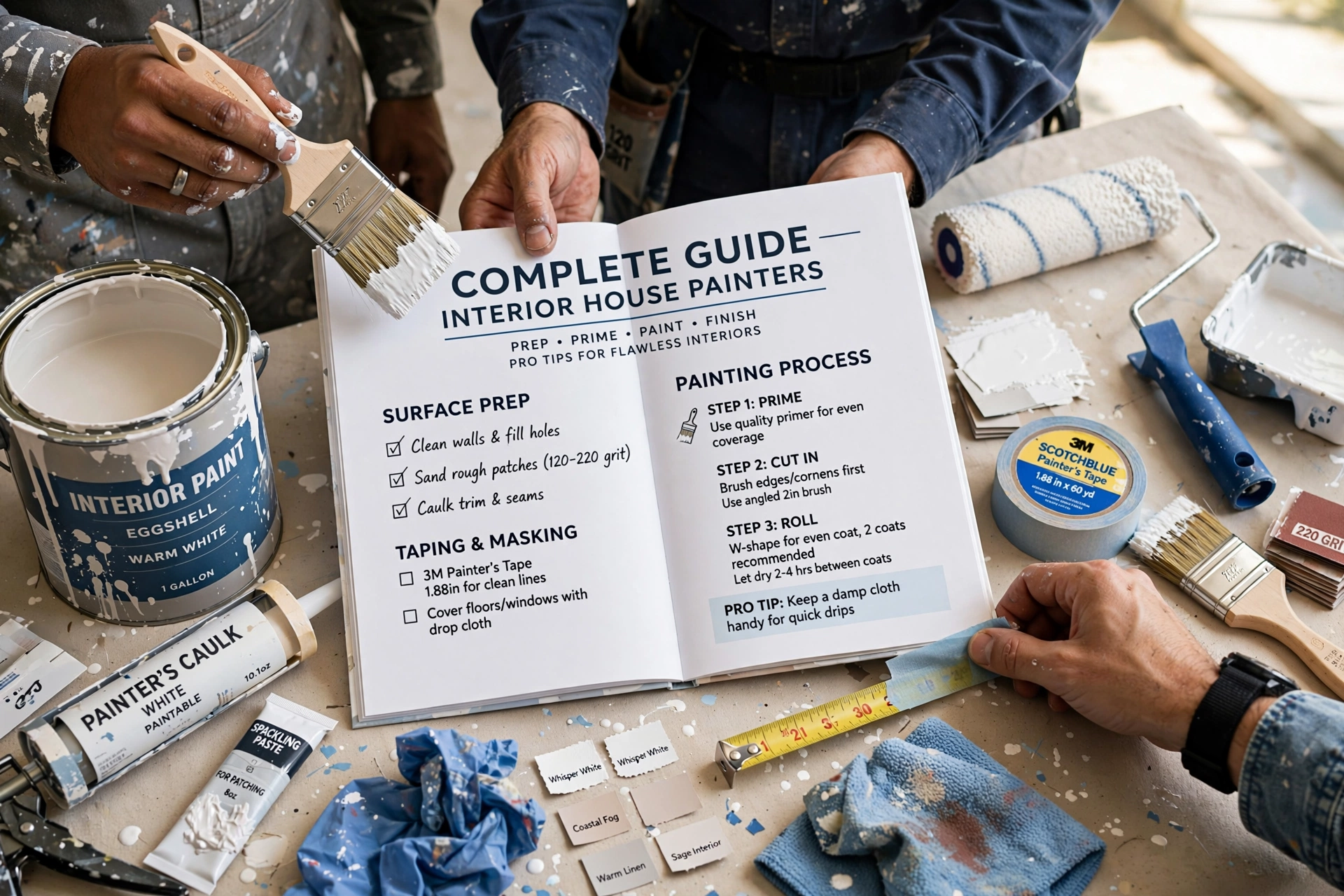


📖This article is part of the complete guide to Interior House Painters.
How to Get the Most Out of Professional Interior Painters
Walking into a room with peeling paint or outdated colors is one thing; managing a crew of professionals to fix it is another. Most homeowners struggle because they treat a paint job as a simple commodity, but the secret to a flawless finish lies in the management of the process. To effectively learn how to use interior house painters, you must shift your focus from "getting a quote" to "managing a specification," ensuring every surface is prepped and every sheen is verified before the first drop of paint hits the wall.
In my experience working with high-end residences across the San Francisco Bay Area, the biggest friction point isn't the painting itself—it's the gap in communication regarding prep work. I've seen homeowners assume "prep" means a quick wipe-down, while a master painter knows it involves a five-step process of cleaning, scraping, sanding, caulking, and priming. When you align these expectations early, you eliminate 90% of the disputes that occur during the final walkthrough.
For those managing larger properties or complexes, understanding the logistics is even more critical. If you are coordinating updates for a residential community, you might look into Multi-Family Painters in Weibel - Fremont, CA to see how professional scaling works in a multi-unit environment.
What Does it Actually Mean to "Use" Interior Painters?
When we talk about how to use interior house painters, we aren't just talking about hiring a person with a brush. We are talking about the strategic deployment of a licensed contractor to increase the asset value of your home while minimizing disruption to your daily life.
📚
Definition
Interior House Painting is a professional architectural coating process that involves surface stabilization, substrate preparation, and the application of specialized pigments designed to withstand indoor humidity, UV exposure, and physical wear.
Using a professional painter effectively means leveraging their technical knowledge of chemistry and physics. For instance, they understand the difference between a "flat" finish (which absorbs light and hides imperfections) and a "semi-gloss" (which reflects light and is scrubbable). According to the Painting Contractors Association (PCA), the longevity of an interior coating is determined by 80% preparation and only 20% application. If you "use" your painters by pushing for a faster timeline at the expense of sanding or priming, you are essentially paying for a product that will peel within 24 months.
In the California Bay Area, this becomes even more complex due to microclimates. A home in the fog-heavy streets of San Francisco requires different moisture-barrier considerations than a home in the heat of the Tri-Valley area. A professional painter doesn't just apply color; they diagnose the environmental stressors affecting your walls.

Why Proper Painter Management Directly Impacts Home Value
The financial implication of a poorly managed paint job is staggering. Paint is the most immediate visual cue for "maintenance" or "neglect" during a home appraisal. When you know how to use interior house painters correctly, you aren't just changing a color; you are performing a critical maintenance task that prevents substrate decay.
Data from real estate trends indicates that a fresh, professionally executed interior paint job can increase a home's perceived value by 2% to 5%. While that sounds small, on a $1.2 million home in Fremont or Palo Alto, that is a swing of $24,000 to $60,000 in equity. The danger lies in "cheap" painting. A low-quality job with visible brush strokes, drips on the baseboards, or "holidays" (missed spots) actually creates a negative psychological impact on buyers, suggesting that other, invisible parts of the home—like plumbing or electrical—were also handled cheaply.
Furthermore, the health implications of improper paint use are real. In older Bay Area homes, particularly Victorians or mid-century builds, the risk of lead-based paint is high. The Environmental Protection Agency (EPA) mandates the RRP (Renovation, Repair, and Painting) rule to ensure that lead dust doesn't contaminate the living space. When you use a licensed contractor, you are paying for the safety protocols and HEPA-filtration systems that prevent your family from inhaling neurotoxins. If you hire an unlicensed "handyman" to save 20%, you are risking a violation of federal safety standards and potentially endangering your household.
The Step-by-Step Guide to Using Interior House Painters
To get a result that lasts a decade rather than a few years, follow this clinical approach to managing your painting project.
Step 1: The Specification Phase
Do not ask for a "quote." Ask for a "scope of work." A quote is a number; a scope of work is a contract of quality. Ensure the document specifies the brands of paint (e.g., Sherwin-Williams or Benjamin Moore), the number of coats, and the exact prep steps.
Step 2: Color Consultation and Sampling
Never choose a color based on a small swatch in a store. Light in the Bay Area varies wildly between the coastal fog of San Mateo and the direct sun of the East Bay. Use your painters to apply 2x2 foot samples on different walls of the room to see how the color shifts from 8 AM to 8 PM.
Step 3: Site Preparation and Protection
This is where most homeowners fail. A professional crew should spend the first half-day exclusively on "masking." This includes using drop cloths, plastic sheeting for furniture, and painter's tape for edges. If a crew starts painting within an hour of arriving, they are rushing the prep. At World Pro Painting, we emphasize a "clean worksite" policy, ensuring that the floor is as protected as the walls.
Step 4: The Five-Step Preparation Process
Verify that your painters are performing these specific actions:
- Cleaning: Removing grease and dust with TSP or a mild detergent.
- Scraping: Removing flaking or bubbling paint.
- Sanding: Smoothing the edges of the old paint (feathering) to prevent visible ridges.
- Caulking: Filling gaps between trim and walls to prevent air leaks and create a seamless look.
- Priming: Applying a bonding agent to seal the surface and ensure the topcoat adheres.
Step 5: The Progressive Walkthrough
Do not wait until the end of the job to inspect the work. Perform a "wet-edge" inspection. Once the first coat is on, check for coverage and opacity. It is much easier to fix a mistake in the first coat than to sand down a fully cured second coat.
💡
Key Takeaway
The most successful painting projects are won or lost in the "prep" phase; verify the sanding and caulking before any paint is applied to ensure a professional-grade finish.
If you are planning a larger renovation, you might also consider how these interior standards apply to your home's shell by reviewing our guide on Exterior Painting in Lakeside, Newark, CA: for 2026.
Comparing Painting Approaches: Manual vs. Cheap AI vs. Professional
Many homeowners are tempted by "DIY kits" or low-cost alternatives. Here is how the professional approach differs from the alternatives.
| Feature | DIY / Manual Approach | Generic/Cheap Contractor | World Pro Painting Approach |
|---|---|---|---|
| Surface Prep | Basic wiping, minimal sanding | Fast scraping, skipping primer | 5-Step prep (Clean, Scrape, Sand, Caulk, Prime) |
| Material Quality | Big-box store generic paint | Lowest cost VOC-compliant paint | Premium Sherwin-Williams / Benjamin Moore |
| Precision | Visible drips, uneven edges | Rushed cutting-in, tape bleeds | Laser-straight lines, precision masking |
| Longevity | 2-3 years before peeling | 3-5 years; prone to fading | 6-Year Guarantee on workmanship |
| Health Safety | Unaware of lead risks | Basic masking | Full EPA-RDP compliance & HEPA filtration |
| Best For | Small touch-ups | Low-budget rentals | High-value homes and professional assets |
Common Misconceptions About Interior Painting
Most guides get this wrong: they tell you to focus on the color. In reality, the color is the least important part of the technical process.
Myth 1: "One coat of high-quality paint is enough."
This is a dangerous falsehood. Even the most expensive paints from Sherwin-Williams require two coats for a uniform finish. A single coat often leaves "streaks" or "holidays" that only become visible when the sun hits the wall at a specific angle. According to industry standards, the second coat provides the necessary "film thickness" to ensure the paint doesn't rub off or fade.
Myth 2: "Priming is only for new drywall."
Incorrect. Priming is essential for any color change, especially when moving from a dark color to a light one, or when painting over a glossy surface. Without a primer, the new paint may "bead" or peel because it cannot bond to the old layer.
Myth 3: "Any licensed contractor is a painting expert."
A general contractor's license (CSLB) is a start, but specialty expertise matters. A painter who specializes in Commercial Painting Cabrillo - Fremont, CA 2026 understands the scale and durability requirements of high-traffic areas, which is very different from a residential "freshen up."
Frequently Asked Questions
How do I know if my interior painters are doing a good job during the process?
You should look for "cutting-in" precision. This is where the paint meets the ceiling or trim. If you see paint bleeding into the white ceiling or onto the wood trim, the masking was insufficient. Additionally, check the texture. Run your hand over a primed area; if you feel ridges or bumps, the sanding phase was skipped. A professional result should feel smooth to the touch, almost like a piece of furniture. If the crew is not using drop cloths or is leaving paint splatters on the flooring, stop the work immediately.
Should I move my own furniture or pay the painters to do it?
While most professional crews can move furniture, it is often safer for the homeowner to handle high-value antiques or fragile items. However, for the logistical flow, it is better to have the painters manage the "staging" of the room. They know exactly how much space they need to move their ladders and sprayers without damaging your walls. At World Pro Painting, we provide a structured staging plan to ensure the room is optimized for efficiency and that your belongings are protected by heavy-duty plastic sheeting.
What is the best way to choose a paint sheen for different rooms?
The rule of thumb is: the higher the traffic, the higher the sheen. For bathrooms and kitchens, a semi-gloss or satin finish is mandatory because these surfaces need to be scrubbed. A flat finish in a kitchen will absorb grease and stains, becoming permanent. For bedrooms and living rooms, a "flat" or "eggshell" finish is preferred because it hides imperfections in the drywall. If you have a wall with many patches, a high-gloss paint will act like a mirror and highlight every single bump.
How long does it actually take for interior paint to "cure" versus "dry"?
This is a critical distinction that many homeowners miss. Paint is "dry to the touch" within 1 to 4 hours, but it is not "cured." Curing is the chemical process where the paint reaches its maximum hardness. According to Benjamin Moore, some paints can take up to 30 days to fully cure. If you lean a heavy piece of furniture against a "dry" wall after 24 hours, you may find the paint has "blocked" or stuck to the furniture. Wait at least 72 hours before placing heavy objects against new walls.
How do I handle a dispute if the paint color looks different than the sample?
First, determine if it is a "metamerism" issue—this is when a color looks different under different light sources. If the paint matches the sample but looks wrong in your room, it is usually a lighting issue. However, if the paint is physically a different hue, it could be a mixing error at the store. This is why we recommend a final walkthrough while the paint is still wet. If the color is wrong, it is much cheaper to change the mix before the second coat is applied than to repaint the entire room.
Final Thoughts on How to Use Interior House Painters
Mastering how to use interior house painters is about transitioning from a passive customer to an active project manager. By focusing on the five-step preparation process, demanding a detailed scope of work, and understanding the chemistry of curing and sheens, you protect your investment and ensure a result that elevates your home's aesthetic.
Don't settle for "good enough" when your home's value is on the line. Whether you are updating a single room or managing a large-scale project, the difference is in the details. If you need a team that treats your home with the precision of a master craftsman, visit World Pro Painting today to schedule your free on-site estimate.
For more specialized local knowledge, explore our guides on Multi-Family Painters Brookvale - Fremont, CA or Exterior Painting in Birch Grove - Newark, CA (2026) to see how we maintain these high standards across the entire Bay Area.
Reference Sources
For deeper context on this topic, these sources provide additional authoritative perspectives:
- Wikipedia — general knowledge reference
- GitHub — development and technology documentation
- The New York Times — news and journalistic updates
These references help establish a complete view of the subject matter.
Commercial Painting Cost Calculator & Color Guide
Get an instant estimation checklist for painting your office, warehouse, or house. Learn how to choose colors that boost productivity.