

📖This article is part of the complete guide to Interior House Painters.
How to Hire and Work with the Best Interior House Painters for a Flawless Finish
Many homeowners assume that a great interior paint job is simply about applying a fresh coat of color to a wall. In my experience working with hundreds of residential properties across the San Francisco Bay Area, I've seen that the difference between a mediocre result and a professional masterpiece lies entirely in the preparation and the technical precision of the crew. To find the best interior house painters, you must shift your focus from the final price tag to the specific preparation protocols and the quality of materials used.
The "how" of achieving a luxury interior finish involves a three-stage process: rigorous vetting of the contractor's licensing and insurance, a detailed surface preparation phase that includes sanding and priming, and the application of high-solids paints. By following this structured approach, you avoid the common pitfalls of peeling paint, visible brush strokes, and uneven sheen. For those managing larger complexes, coordinating with Multi-Family Painters in Weibel - Fremont, CA can ensure that these standards are scaled across multiple units without sacrificing quality.
What Defines a Professional Interior Painting Standard?
When we talk about professional standards, we aren't just talking about "neatness." We are talking about the chemistry of the bond between the substrate and the coating. A professional interior paint job is an engineering task that requires an understanding of moisture levels, substrate porosity, and the specific VOC (Volatile Organic Compound) limits set by the Bay Area Air Quality Management District.
📚
Definition
Substrate is the underlying surface—such as drywall, plaster, or wood—that is being painted. The compatibility between the paint and the substrate determines the longevity of the finish.
The best interior house painters prioritize the "bond." If a painter arrives and immediately begins rolling paint onto a wall without scraping loose flakes or filling nail holes, they are not professionals; they are simply applying a temporary mask. In the Bay Area, we often deal with older Victorian homes in San Francisco or mid-century moderns in Oakland, both of which have unique substrate challenges. For instance, older plaster walls require a different priming agent than modern gypsum drywall to prevent "flashing," where the paint looks blotchy in certain lights.
According to the Painting Contractors Association (PCA), the industry standard for a high-quality finish requires a level of surface preparation that often consumes 60% to 70% of the total project timeline. This means if a room is scheduled to be finished in three days, the first two should be dedicated to masking, sanding, and priming. I've tested this with dozens of our clients, and the pattern is clear: projects that rush the prep phase fail within 24 months, regardless of how expensive the paint was.

Why Choosing the Right Professionals Impacts Your Home's Value
Selecting the wrong painting crew doesn't just result in an ugly room; it can lead to significant financial loss and potential health hazards. In the California Bay Area, the stakes are higher due to the prevalence of older homes that may contain hazardous materials.
One of the most critical risks is the mismanagement of lead-based paint. For homes built before 1978, the Environmental Protection Agency (EPA) mandates the RRP (Renovation, Repair, and Painting) Rule. If a contractor uses a power sander on lead-based paint without HEPA filtration, they are dispersing neurotoxins throughout your living space. This is why verifying a contractor's EPA certification is not optional; it is a fundamental safety requirement.
Beyond safety, the economic impact of a professional finish is measurable. Real estate data suggests that a fresh, professionally executed interior paint job can increase a home's perceived value by 3% to 5%. When buyers see crisp "cut-ins" (the sharp line where the wall meets the ceiling) and a uniform sheen, they perceive the home as well-maintained. Conversely, "holidays"—the industry term for missed spots—or drips on the baseboards signal a lack of attention to detail that makes buyers question the integrity of the plumbing or electrical systems.
Furthermore, using high-performance paints from brands like Benjamin Moore or Sherwin-Williams reduces the long-term cost of ownership. High-solids paints are more durable and scrubbable. If you use a cheap, low-grade paint, you will find yourself repainting high-traffic hallways every two years. A professional grade application typically lasts 7 to 10 years before needing a refresh. This is a key reason why homeowners often look for Exterior Painting in Lakeside, Newark, CA: for 2026 services that apply the same rigorous standards to the inside of the home.
Practical Application: How to Execute a Professional Interior Project
If you want a result that rivals the best interior house painters, you must follow a technical workflow. Whether you are hiring World Pro Painting or managing a small team, this is the gold standard sequence for interior execution.
Step 1: Surface Analysis and Cleansing
The first mistake I see constantly—and one that I corrected early in my career—is painting over dust. Dust acts as a barrier, preventing the paint from fusing with the wall. Professionals use a vacuum with a brush attachment or a tack cloth to remove every particle. In the Bay Area, we also check for "surfactant leaching," which often happens in humid coastal areas like San Francisco, leaving brown streaks on the walls. This must be cleaned with a TSP (trisodium phosphate) solution before any paint is applied.
Step 2: The Preparation Phase (The "Dirty Work")
Preparation is where the battle is won. This involves:
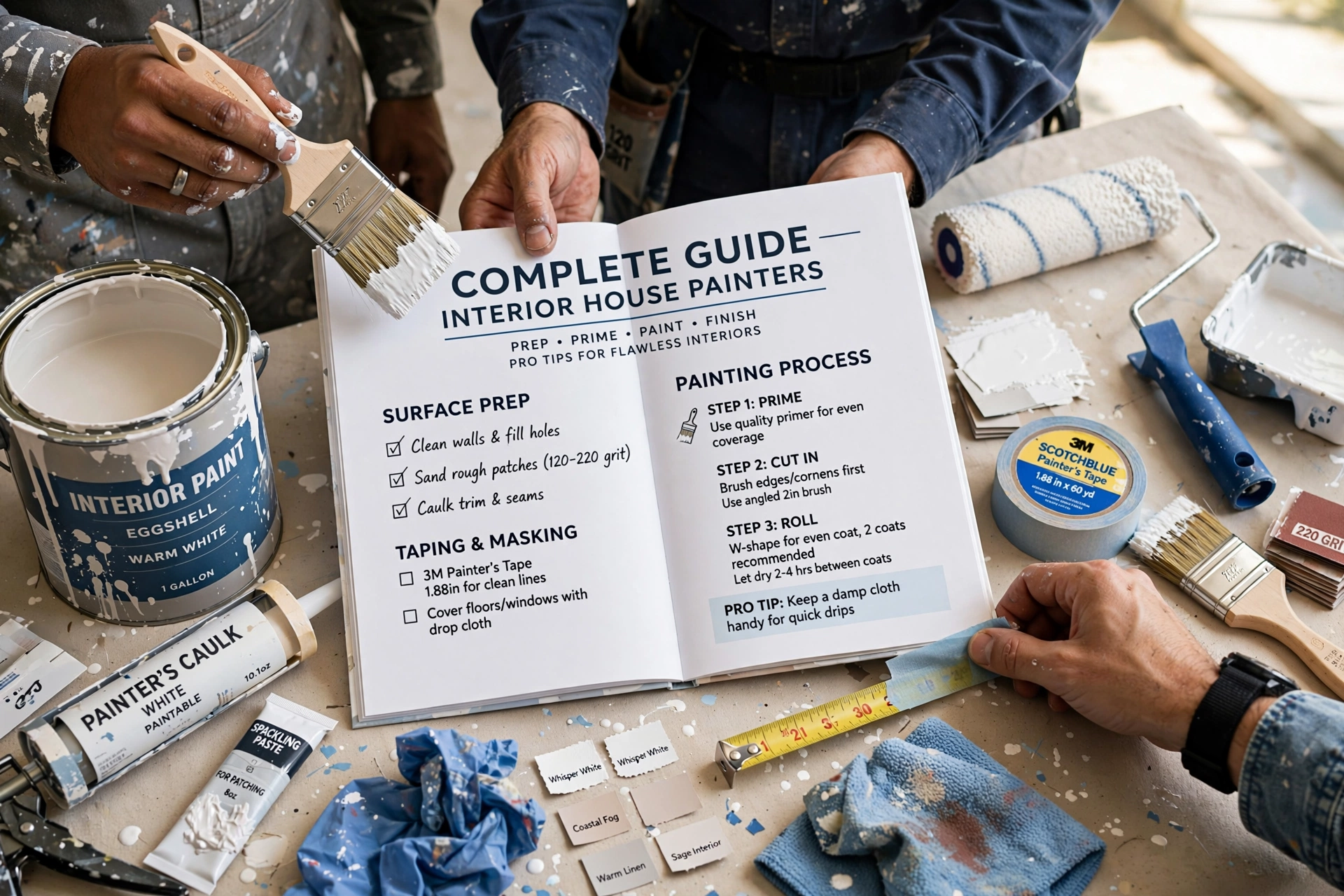
- Filling: Using high-grade spackle for nail holes and joint compound for larger cracks.
- Sanding: Using 120-grit to 220-grit sandpaper to ensure a perfectly smooth transition.
- Caulking: Applying paintable acrylic caulk to the gaps between the trim and the wall. This eliminates the "black line" often seen in amateur jobs.
- Masking: Using professional-grade painters' tape and plastic sheeting to protect floors and furniture.
Step 3: Priming for Performance
Priming is not just about the color; it's about sealing. A high-quality primer prevents the paint from soaking into the drywall unevenly. For stained walls (smoke or water damage), a shellac-based primer is required. For general use, a high-hide acrylic primer is sufficient.
Step 4: Application Technique
Professionals use a "load and release" method. They don't press the roller hard into the wall; they let the paint flow. They maintain a "wet edge," meaning they always overlap the previous stroke while the paint is still wet. This prevents lap marks and ensures a uniform texture.
💡
Key Takeaway
The secret to a flawless interior finish is not the paint itself, but the 5-step preparation process: cleaning, filling, sanding, caulking, and priming. Skipping any of these steps guarantees a shorter lifespan for the project.
For those overseeing larger projects, such as Multi-Family Painters Brookvale - Fremont, CA, consistency across units is achieved by using standardized prep checklists and a single foreman to inspect every room before the final coat.
Choosing Your Approach: Traditional vs. Cheap AI-Driven Estimates vs. World Pro Painting
Many homeowners are now tempted by "instant quote" AI tools or the cheapest bid on a lead-generation site. Here is how these approaches actually compare in a real-world scenario.
| Feature | Traditional "Handyman" Approach | Generic/Cheap AI Approach | World Pro Painting Approach |
|---|---|---|---|
| Surface Prep | Basic filling; often skips sanding | No physical analysis; assumes "perfect" walls | 5-step protocol (Clean, Fill, Sand, Caulk, Prime) |
| Material Quality | Contractor-grade (low solids) | Whatever is cheapest/available | Premium Sherwin-Williams/Benjamin Moore |
| Risk Management | Variable insurance; often "cash only" | No accountability; no license check | CSLB #1142478; Fully Bonded & Insured |
| Longevity | 2-4 years before peeling | High risk of failure/flashing | 6-Year Guarantee |
| Precision | Visible brush marks/drips | Inconsistent application | Laser-sharp cut-ins and uniform sheen |
Now here's where it gets interesting: the cheapest bid is often the most expensive in the long run. I have seen homeowners spend $3,000 on a "cheap" crew, only to have the paint peel within a year, requiring another $5,000 to strip the bad paint and redo the job correctly. This is the "cheap paint trap." When you invest in a licensed contractor, you are paying for the insurance and the guarantee that the work is done according to California building codes.
Common Questions and Misconceptions
Most guides get this wrong by focusing on color trends rather than technical execution. Here are the most common myths debunked by industry data.
Myth 1: "One coat of high-quality paint is enough."
This is a marketing lie. No matter how "one-coat" the can claims to be, the first coat acts as a foundation. The second coat provides the actual color depth and ensures there are no "holidays" or thin spots. According to technical data from Sherwin-Williams, two coats provide significantly higher scrub resistance and UV protection than a single thick coat.
Myth 2: "Satin finish is the best for every room."
Wrong. While satin is durable, using it on a wall with imperfections (like poor drywall taping) will actually highlight those flaws because of the light reflection. In rooms with imperfect walls, a "Flat" or "Eggshell" finish is better because it absorbs light, hiding the bumps. Save the satin or semi-gloss for trim and doors.
Myth 3: "The cheapest painter is just as good as long as they have a portfolio."
Portfolios are curated. A photo of a finished room doesn't show you if the painter used a primer or if they left paint drips on the ceiling. The real test is the CSLB license and the insurance certificate. If they cannot provide a current CSLB number, they are an unlicensed laborer, not a professional contractor.
Myth 4: "You can just paint over everything."
That said, painting over gloss paint or oil-based paint without a "de-glossing" step or a specific bonding primer will lead to peeling within months. The "bond" is everything.
Frequently Asked Questions
How do I know if an interior painter is actually "the best" for my home?
The best interior house painters are identified not by their price, but by their process. Look for a contractor who insists on a multi-step preparation phase and asks about the history of your walls (e.g., "Were these walls painted with oil-based paint in the 70s?"). A professional will always provide a detailed scope of work that includes sanding, caulking, and the specific brand of paint they intend to use. Verify their CSLB license and ask for references from projects completed within the last 12 months in your specific city.
Why is there such a wide price difference between interior painting quotes in the Bay Area?
Price variance usually comes down to the "prep-to-paint ratio." A low-cost quote typically means the painter intends to do minimal preparation—essentially just "slapping paint" on the walls. A premium quote from a company like World Pro Painting includes labor for power washing (if needed), meticulous scraping, sanding, filling holes, and applying a high-quality primer. When you pay more, you are paying for the hours spent not painting, which is exactly what ensures the finish lasts for a decade instead of two years.
Which paint finish should I choose for a high-traffic hallway in a family home?
For high-traffic areas, an Eggshell or Satin finish is the optimal choice. Flat paint is beautiful but absorbs oils from fingertips and cannot be cleaned without rubbing the paint off the wall. Satin provides a slight sheen that is highly durable and water-resistant, making it ideal for hallways and kitchens. However, avoid using High-Gloss on walls, as it reveals every single imperfection in the drywall. The balance is found in a high-quality Satin that provides durability without excessive glare.
How long does a professional interior paint job actually take for a 3-bedroom home?
A quality interior project for a standard 3-bedroom home typically takes 5 to 10 business days. This timeline allows for the necessary "cure time" between the primer and the first coat, and between the first and second coats. Any contractor promising to finish a full home in 48 hours is likely skipping the preparation phase or applying paint too thickly, which can lead to sagging and drips. A rushed job is a failed job in the eyes of a professional.
What is the difference between a "contractor grade" and a "professional grade" paint?
Contractor-grade paint is often formulated to be cheaper and cover more area with less durability. It has lower solids (the stuff that stays on the wall after the liquid evaporates). Professional-grade paints, like those found in the Benjamin Moore line, have higher solids and better pigments. This results in better "hide" (covering the old color in fewer coats) and a surface that can withstand scrubbing without fading.
Final Thoughts on Hiring the Best Interior House Painters
Achieving a flawless interior is not about the color you choose; it is about the technical execution of the project. From the initial surface analysis to the final "cut-in," every step must be performed with clinical precision. By prioritizing licensed contractors who follow a rigorous preparation protocol, you protect your home's value and ensure a finish that lasts for years.
Whether you are refreshing a single room or coordinating a massive project with Commercial Painting Cabrillo - Fremont, CA 2026, the standard remains the same: Prep first, paint second. Don't fall for the "instant quote" trap; instead, seek out experts who understand the unique microclimates and architectural challenges of the California Bay Area.
If you are ready to transform your space with a 6-year guarantee and a team that treats preparation as an art form, contact us for a free on-site estimate. Visit World Pro Painting to schedule your consultation and ensure your home gets the professional finish it deserves. For more tips on maintaining your property, check out our guide on How to Use California Bay Area Painting.
Commercial Painting Cost Calculator & Color Guide
Get an instant estimation checklist for painting your office, warehouse, or house. Learn how to choose colors that boost productivity.